


Page 354 - Plastics Engineering
P. 354
Processing of Plastics                                         337

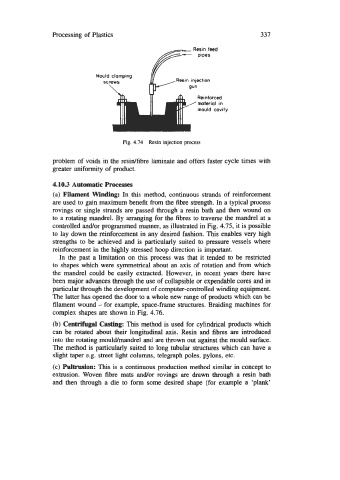
                                                            Resin feed
                                                             pipes


                              Mould clamping
                                screws                 Resin injection
                                  \
                                                             Reinforced
                                                             material in
                                                             mould  cavity


                                      Fig. 4.74  Resin injection process


                 problem of  voids in the residfibre laminate and offers faster cycle times with
                 greater uniformity of product.

                 4.10.3 Automatic Pr~~esses
                 (a) Filament Winding:  In  this method, continuous strands of  reinforcement
                 are used to gain maximum benefit from the fibre strength. In a typical process
                 rovings or single strands are passed through a resin bath and then wound on
                 to a rotating mandrel. By arranging for the fibres to traverse the mandrel at a
                 controlled and/or programmed manner, as illustrated in Fig. 4.75, it is possible
                 to lay down the reinforcement in any desired fashion. This enables very high
                 strengths to be  achieved and is particularly suited to pressure vessels where
                 reinforcement in the highly stressed hoop direction is important.
                   In  the past  a limitation on  this process was that it tended to be restricted
                 to shapes which were symmetrical about an axis of  rotation and from which
                 the mandrel could be  easily extracted. However, in  recent years there have
                 been major advances through the use of collapsible or expendable cores and in
                 particular through the development of computer-controlled winding equipment.
                 The latter has opened the door to a whole new range of products which can be
                 filament wound - for example, space-frame structures. Braiding machines for
                 complex shapes are shown in Fig. 4.76.
                 (b) Centrifugal Casting: This method is used for cylindrical products which
                 can be  rotated about their longitudinal axis. Resin and  fibres are introduced
                 into the rotating mould/mandrel and are thrown out against the mould surface.
                 The method is particularly suited to long tubular structures which can have a
                 slight taper e.g. street light columns, telegraph poles, pylons, etc.
                 (c) Pultrusion: This is a continuous production method similar in concept to
                 extrusion. Woven  fibre mats  and/or  rovings are drawn through a  resin bath
                 and then  through a die to form  some desired shape (for example a  ‘plank’

