


Page 358 - Plastics Engineering
P. 358
Processing of Plastics                                         34 1

                                    t-       220 dia


                            4


                                                    3


                 the position and magnitude of the maximum pressure. The density of  the material is  1400 kg/m3
                 and its viscosity is  1.5 x  104 Ns/m2.
                   4.9  A  calender having rolls of  0.2 m diameter produces 2 mm  thick plastic sheet at a linear
                 velocity  of  0.1 ds. Investigate the effect of  nips in  the  range  0.8 to  1.9 mm  on  the pressure
                 profile. The viscosity is  lo3 Ns/m2.
                   4.10  A  hemispherical dome of  200 mm diameter has been  vacuum formed from a flat sheet
                 4 mm thick. What is the thickness of the dome at the point furthest away from its diameter.
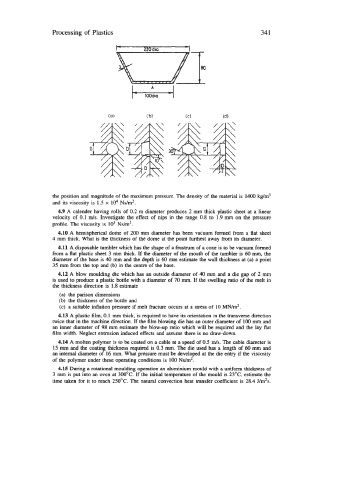
                   4.11 A disposable tumbler which has the shape of a frustrum of a cone is to be vacuum formed
                 from a flat plastic sheet 3 mm thick. If  the diameter of  the mouth of  the tumbler is 60 mm, the
                 diameter of the base is 40 mm and the depth is 60 mm estimate the wall thickness at (a) a point
                 35  mm from the top and (b) in the centre of the base.
                   4.12  A blow  moulding die which has an outside diameter of  40 mm and a die gap of  2 mm
                 is used to produce a plastic bottle with a diameter of 70 mm. If  the swelling ratio of  the melt in
                 the thickness direction is 1.8 estimate
                   (a)  the parison dimensions
                   (b) the thickness of  the bottle and
                   (c) a suitable inflation pressure if  melt fracture occurs at a stress of  10 MN/m2.
                   4.13  A plastic film, 0.1 mm thick, is required to have its orientation in the transverse direction
                 twice that in the machine direction. If the film blowing die has an outer diameter of  100 mm and
                 an inner diameter of 98 mm estimate the blow-up ratio which will  be required and the lay flat
                 film width. Neglect extrusion induced effects and assume there is no draw-down.
                   4.14  A molten polymer is to be. coated on a cable at a speed of 0.5 ds. The cable diameter is
                 15 mm and the coating thickness required is 0.3 mm.  The die used has a length of  60 mm and
                 an internal diameter of  16 mm. What pressure must be developed at the die entry if the viscosity
                 of the polymer under these operating conditions is 100 Ns/m2.
                   4.15  During a rotational moulding operation an aluminium mould with a uniform thickness of
                 3 mm  is put into an oven at 300°C.  If  the initial temperature of the mould is 23°C.  estimate the
                 time taken for it to reach  250°C. The natural convection heat transfer coefficient is 28.4 J/m2s.

