


Page 349 - Plastics Engineering
P. 349
332                                             Processing of  Plastics

                                  Chopped fibre


                                      Mould ’            ‘ Moulding


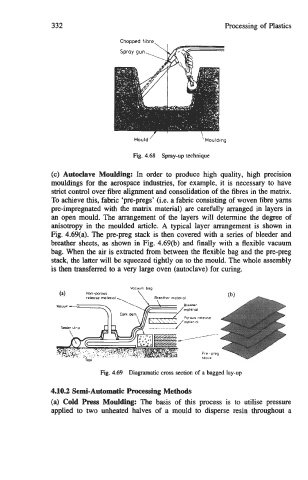
                                      Fig. 4.68  Spray-up technique

               (c) Autoclave Moulding:  In  order to  produce high  quality, high  precision
               mouldings for the aerospace industries, for example, it is necessary to have
               strict control over fibre alignment and consolidation of the fibres in the matrix.
               To achieve this, fabric ‘pre-pregs’ (i.e. a fabric consisting of woven fibre yarns
               pre-impregnated with the matrix material) are carefully arranged in layers in
               an open mould. The arrangement of  the layers will  determine the degree of
               anisotropy in  the  moulded  article. A  typical layer  arrangement is  shown in
               Fig. 4.69(a).  The pre-preg stack is then covered with a series of  bleeder and
               breather sheets, as shown in Fig. 4.69(b) and finally with a flexible vacuum
               bag. When the air is extracted from between the flexible bag and the pre-preg
               stack, the latter will be squeezed tightly on to the mould. The whole assembly
               is then transferred to a very large oven (autoclave) for curing.


                                                    Pwous releose


                             Fig. 4.69  Diagramatic cross section of a bagged lay-up

               4.10.2  Semi-Automatic Processing Methods
               (a) Cold Press  Moulding:  The  basis  of  this  process  is  to  utilise pressure
               applied to  two  unheated  halves  of  a  mould  to  disperse resin  throughout a

