


Page 347 - Plastics Engineering
P. 347
330                                             Processing of Plastics
                  The Semi-Automatic processes include processes such as cold pressing, hot
                pressing, compression moulding of SMC and DMC, resin injection.
                  The Automatic  processes are  those  such  as  pultrusion,  filament winding,
                centrifugal casting and injection moulding.
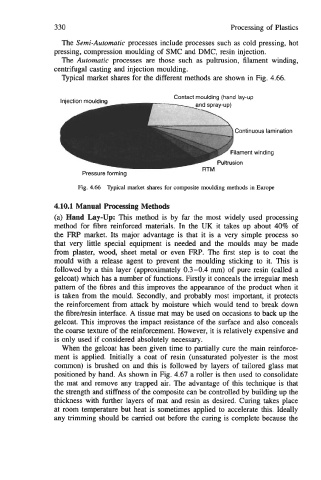
                  Qpical market shares for the different methods are shown in Fig. 4.66.


                                                 Contact moulding (hand lay-up
                  Injection moulding
                                                       -->  ;pray-up)


                                                                 Continuous lamination

                                                                 ilament winding
                                                          r
                                                            Pultrusion
                                                        n iM
                       Pressure forming
                      Fig. 4.66  npical market shares for composite moulding methods in Europe

                4.10.1 Manual Processing Methods
                (a) Hand Lay-Up: This method is  by  far the most  widely  used processing
                method for  fibre reinforced  materials. In  the  UK  it  takes up  about 40% of
                the FRP market.  Its major  advantage is that  it  is  a  very  simple process  so
                that  very  little  special equipment is  needed  and  the  moulds  may  be  made
                from plaster,  wood,  sheet metal  or even FRP. The  first step is  to  coat the
                mould  with  a  release  agent  to  prevent  the  moulding  sticking to  it.  This is
                followed by  a thin layer (approximately 0.3-0.4 mm) of  pure resin (called a
                gelcoat) which has a number of functions. Firstly it conceals the irregular mesh
                pattern of  the fibres and this improves the appearance of  the product when it
                is taken from the mould. Secondly, and probably most important, it protects
                the reinforcement from attack by  moisture which  would tend  to break down
                the fibrehesin interface. A tissue mat may be used on occasions to back up the
                gelcoat. This improves the impact resistance of  the surface and also conceals
                the coarse texture of the reinforcement. However, it is relatively expensive and
                is only used if considered absolutely necessary.
                  When the gelcoat has been given time to partially cure the main reinforce-
                ment  is  applied. Initially  a  coat of  resin  (unsaturated polyester  is  the  most
                common) is brushed on and this is followed by  layers of  tailored glass mat
                positioned by hand. As shown in Fig. 4.67 a roller is then used to consolidate
                the mat and remove any trapped air. The advantage of  this technique is that
                the strength and stiffness of the composite can be controlled by building up the
                thickness with further layers of  mat and resin as desired. Curing takes place
                at room temperature but heat is sometimes applied to accelerate this. Ideally
                any trimming should be carried out before the curing is complete because the

