


Page 343 - Plastics Engineering
P. 343
326                                             Processing of Plastics
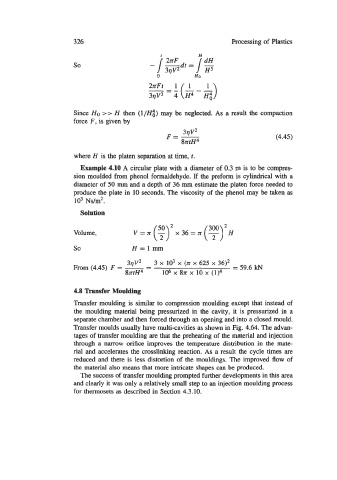
                                              - Jwdt=  Jq
                                                 t
                                                             H
                                                   2nF
                       so
                                                               H
                                                0           Ho


                       Since Ho >> H then (l/H;)  may be neglected. As  a result the compaction
                       force F, is given by

                                                                                    (4.45)


                       where H is the platen separation at time, t.
                         Example 4.10 A circular plate with a diameter of 0.3 m is to be compres-
                       sion moulded from phenol formaldehyde. If  the preform is cylindrical with a
                       diameter of 50 mm and a depth of  36 mm estimate the platen force needed to
                       produce the plate in  10 seconds. The viscosity of  the phenol may be taken as
                       lo3 Ns/m2.
                         Solution
                                                      x 36=n (7)’H
                       Volume,           V=n (;)2

                       so                H=lmm

                                       3qV2     3 x lo3 x (n x 625 x 36)’
                       From (4.45) F = -                               = 59.6 kN
                                             -
                                       8ntH4 -  106 x 8n x io x (1)4
                       4.8 Transfer Moulding
                       Transfer moulding is similar to compression moulding except that instead of
                       the moulding material being pressurized in  the cavity, it is pressurized in  a
                       separate chamber and then forced through an opening and into a closed mould.
                       Transfer moulds usually have multi-cavities as shown in Fig. 4.64. The advan-
                       tages of transfer moulding are that the preheating of the material and injection
                       through a narrow orifice improves the temperature distribution in  the mate-
                       rial and accelerates the crosslinking reaction. As a result the cycle times are
                       reduced and there is less distortion of  the mouldings. The improved flow of
                       the material also means that more intricate shapes can be produced.
                         The success of transfer moulding prompted further developments in this area
                       and clearly it was only a relatively small step to an injection moulding process
                       for thermosets as described in Section 4.3.10.

