


Page 338 - Plastics Engineering
P. 338
Processing of Plastics                                         321

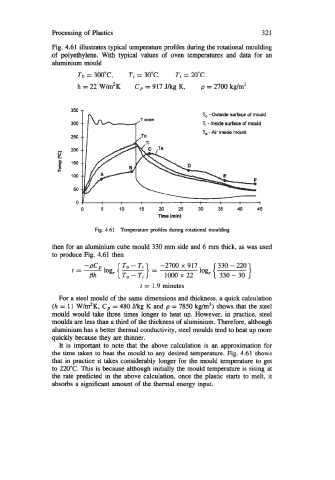
                 Fig. 4.61 illustrates typical temperature profiles during the rotational moulding
                 of  polyethylene. With  typical  values  of  oven  temperatures and  data  for  an
                 aluminium mould
                        To = 300"C,     Ti = 30°C,    T, = 20°C

                        h = 22 W/m2K      C, = 917 Jkg K,     p = 2700 kg/m3


                      350

                      300                                     T, - Inside surface of mould
                                                              T,  - Air inside mould
                      250

                  E   200
                   E
                  I-   ls0
                       100
                       50

                        0
                         0     5     10    15    20    25    30    35    40    45
                                                 Time (min)

                              Fig. 4.61  Temperature profiles during rotational moulding

                 then for an aluminium cube mould 330 mm side and 6 mm thick, as was used
                 to produce Fig. 4.61 then
                                      To - Tt    -2700  x 917      330 - 220
                       r=*loge{-}=    To - Ti      lo00 x 22  loge { 330 - 30 }
                            Bh
                                           r  = 1.9 minutes
                   For a steel mould of the same dimensions and thickness, a quick calculation
                 (h = 11 W/m2K, C, = 480 Jkg K and p = 7850 kg/m3) shows that the steel
                 mould would take three times longer to heat up.  However, in practice, steel
                 moulds are less than a third of the thickness of aluminium. Therefore, although
                 aluminium has a better thermal conductivity, steel moulds tend to heat up more
                 quickly because they are thinner.
                   It is important to  note that the above calculation is an approximation for
                 the time taken to heat the mould to any desired temperature. Fig. 4.61  shows
                 that in practice it takes considerably longer for the mould temperature to get
                 to 220°C. This is because although initially the mould temperature is rising at
                 the rate predicted in the above calculation, once the plastic starts to melt, it
                 absorbs a significant amount of  the thermal energy input.

