


Page 205 - Practical Control Engineering a Guide for Engineers, Managers, and Practitioners
P. 205
Distributed  Processes   179


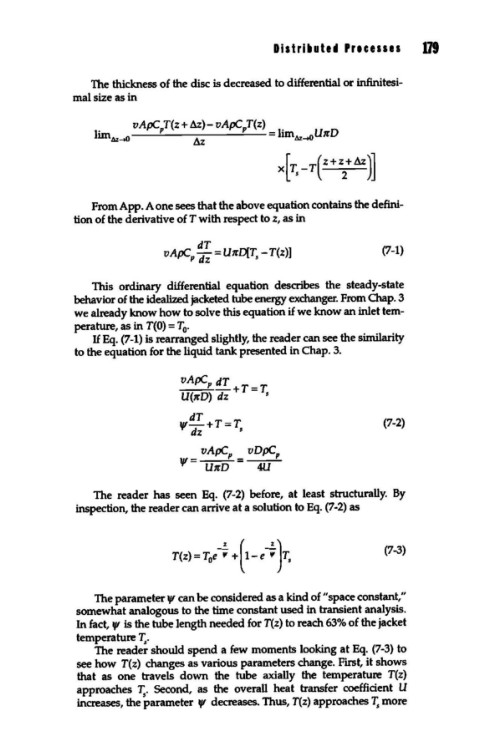
                The thickness of the disc is decreased to differential or infinitesi-
             mal size as in


                From App. A one sees that the above equation contains the defini-
             tion of the derivative ofT  with respect to z, as in

                                  dT
                            vApCP Tz = U1rD(T - T(z)]            (7-1)
                                            5
                This  ordinary  differential  equation  describes  the  steady-state
             behavior of the idealized jacketed tube energy exchanger. From Chap. 3
             we already know how to solve this equation if  we know an inlet tem-
             perature, as in T(O) = T •
                                0
                If  Eq. (7-1) is rearranged slightly, the reader can see the similarity
             to the equation for the liquid tank presented in Chap. 3.
                               vApCpdT
                               U(1rD) Tz +  T =  Ts
                                 dT
                               ytdz+T=Ts                         (7-2)

                                   vApCP   vDpCP
                               Yl = U1rD  =  --ru-

                 The  reader  has  seen  Eq.  (7-2)  before,  at  least  structurally.  By
              inspection, the reader can arrive at a solution to Eq. (7-2) as


                                                                 (7-3)


                 The parameter yt can be considered as a kind of  Space constant,"
                                                       11
              somewhat analogous to the time constant used in transient analysis.
              In  fact, yt is the tube length needed for T(z) to reach 63% of the jacket
              temperature ~-
                 The reader should spend a few moments looking at Eq. (7-3) to
              see how  T(z)  changes as various parameters change. First, it shows
              that  as  one  travels  down  the  tube  axially  the  temperature  T(z)
              approaches  ~- Second,  as  the  overall  heat  transfer  coefficient  U
              increases, the parameter  yt  decreases. Thus, T(z) approaches ~  more

