


Page 206 - Practical Control Engineering a Guide for Engineers, Managers, and Practitioners
P. 206
180  Chapter  Seven


                     1
                   0.95        ......
                    0.9
                   0.85                 . .  ..   ..  . .  '.   •   •   I   •   •
                 ~   0.8                         ..  . .  . .
                 e
                 Ill  0.75              ..
                 ~
                 ~   0.7
                   0.65

                    0.6
                   0.55
                    0.50
                           0.5   1   1.5   2    2.5   3   3.5   4
                                      Axial distance z

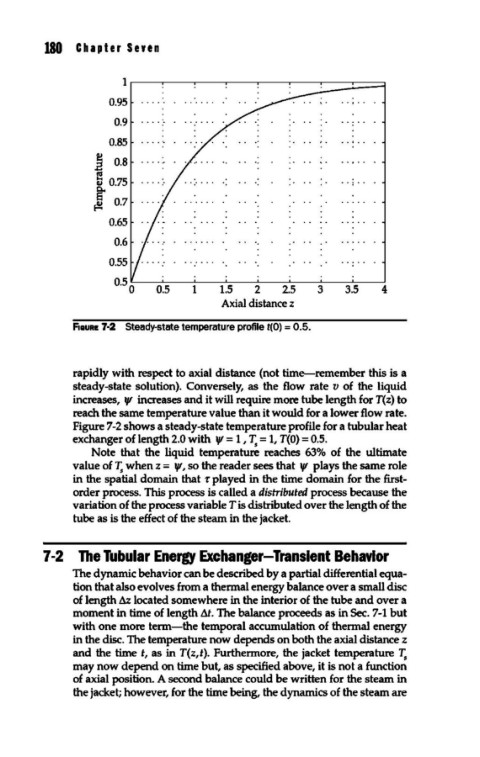
             fiGURE 7·2  Steady-state temperature profile t(O) = 0.5.


             rapidly with respect to axial distance (not time-remember this is a
             steady-state solution).  Conversely, as the flow  rate v  of the liquid
             increases,  yt  increases and it will require more tube length for T(z) to
             reach the same temperature value than it would for a lower flow rate.
             Figure 7-2 shows a steady-state temperature profile for a tubular heat
             exchanger of length 2.0 with  yt = 1 , ~ = 1, T(O) = 0.5.
                Note  that  the  liquid  temperature  reaches  63%  of the  ultimate
             value of~ when z =  yt, so the reader sees that  yt  plays the same role
             in the spatial domain that 'f played in the time domain for the first-
             order process. This process is called a distributed process because the
             variation of the process variable Tis distributed over the length of the
             tube as is the effect of the steam in the jacket.


        7-2  The Tubular Energy Exchanger-Transient Behavior
             The dynamic behavior can be described by a partial differential equa-
             tion that also evolves from a thermal energy balance over a small disc
             of length Az located somewhere in the interior of the tube and over a
             moment in time of length At. The balance proceeds as in Sec. 7-1 but
             with one more term-the temporal accumulation of thermal energy
             in the disc. The temperature now depends on both the axial distance z
             and the time t, as in T(z,t). Furthermore, the jacket temperature  ~
             may now depend on time but, as specified above, it is not a function
             of axial position. A second balance could be written for the steam in
             the jacket; however, for the time being, the dynamics of the steam are

