


Page 210 - Practical Control Engineering a Guide for Engineers, Managers, and Practitioners
P. 210
184  Chapter  Seven


                So,  we have solved Eq.  (7-9)  for  the spatial dependence of the
             temperature with the Laplace transforms as a parameter. Alterna-
             tively, we could look at Eq. (7-10) as the Laplace transform of T{z,t)
             with the spatial dimension z as a parameter.

             7-3-1  Inlet Temperature Transfer Function
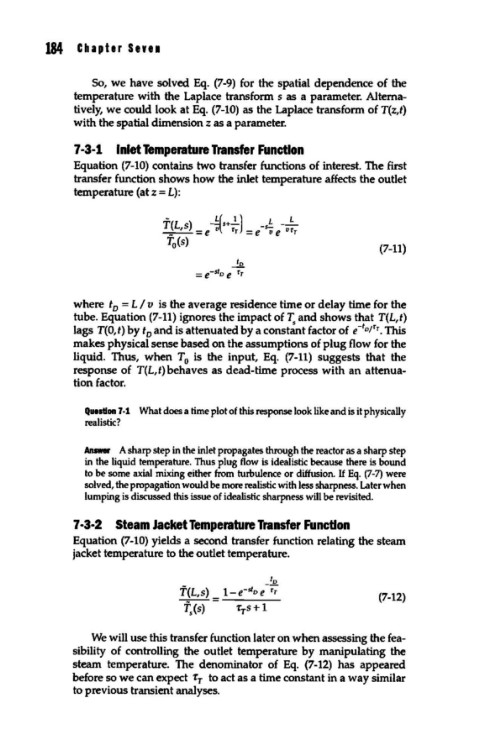
             Equation (7-10) contains two transfer functions of interest. The first
             transfer function shows how the inlet temperature affects the outlet
             temperature (at z = L):

                            T(L s)   - L( s+..!..)   L  -....!::....
                            ---'- = t  V\.  rT  = t -SV t  vrT
                             T (s)
                              0                                 (7-11)


             where  t  =  L I v  is the average residence time or delay time for the
                    0
             tube. Equation (7-11) ignores the impact of~  and shows that T(L,t)
                                                             1
             lags T(O,t) by t and is attenuated by a constant factor of e- v/rT. This
                         0
             makes physical sense based on the assumptions of plug flow for the
             liquid.  Thus,  when  T is  the  input,  Eq.  (7-11)  suggests  that  the
                                0
             response of  T(L,t) behaves as dead-time process with an attenua-
             tion factor.
               Question 7-1  What does a time plot of this response look like and is it physically
               realistic?
               Answer  A sharp step in the inlet propagates through the reactor as a sharp step
               in the liquid temperature. Thus plug flow is idealistic because there is bound
               to be some axial mixing either from turbulence or diffusion. U Eq.  (7-7)  were
               solved, the propagation would be more realistic with less sharpness. Later when
               lumping is discussed this issue of idealistic sharpness will be revisited.

             7-3-2  Steam Jacket Temperature Transfer Function
             Equation (7-10) yields a second transfer function relating the steam
             jacket temperature to the outlet temperature.

                                              to
                               f(L,s) _ 1- e-sto e -r;
                                                                (7-12)
                                T(s)  -  -r s +  1
                                         1
                                5
                We will use this transfer function later on when assessing the fea-
             sibility  of controlling  the  outlet temperature by manipulating the
             steam  temperature.  The  denominator  of  Eq.  (7-12)  has  appeared
             before so we can expect  T 1  to act as a time constant in a way similar
             to previous transient analyses.

