


Page 212 - Practical Control Engineering a Guide for Engineers, Managers, and Practitioners
P. 212
186  Chapter  Seven


                     0.9 r;:::::::;:~::::::::~:::::::::==:::::;--:--.--~-:-~
                         -Outlet temperature
                     0.8   Undelayed component     .. ·  ...  ;.:.-··:·
                         .  -.Delayed component
                     0.7                      ••  ·.t
                   ~ 0.6
                  -;                          Uc = 1 L = 1 v = 1
                   R.  0.5
                   e                          rr = 1
                  ~ 0.4
                  ~                           t 0 /rr = 1
                   :s  0.3
                  0
                     0.2


                      0
                       0   0.2  0.4  0.6  0.8   1   1.2  1.4  1.6  1.8   2
                                         Tune
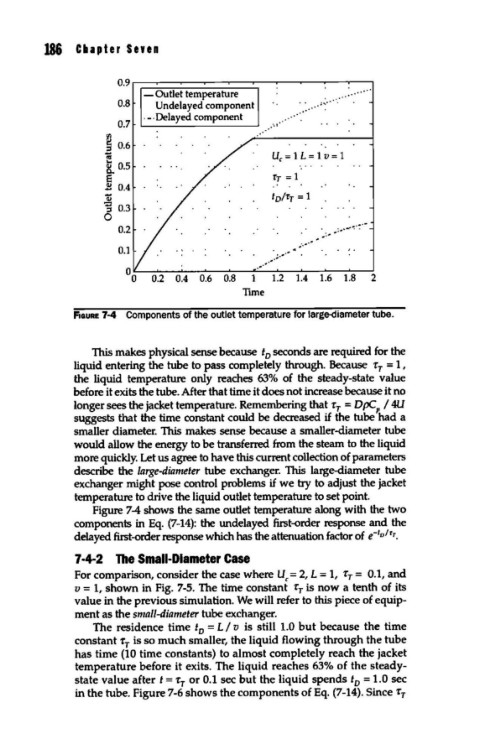
             FIGURE 7-4  Components of the outlet temperature for large-diameter tube.


                This makes physical sense because t  seconds are required for the
                                             0
             liquid entering the tube to pass completely through. Because  rr = 1 ,
             the  liquid  temperature  only  reaches  63%  of  the  steady-state  value
             before it exits the tube. After that time it does not increase because it  no
             longer sees the jacket temperature. Remembering that rr = DpCP. I 4U
             suggests that the time constant could be decreased if the tube had a
             smaller diameter. This makes sense because a smaller-diameter tube
             would allow the energy to be transferred from the steam to the liquid
             more quickly. Let us agree to have this current collection of parameters
             describe the large-diameter  tube exchanger. This  large-diameter tube
             exchanger might pose control problems if we try to adjust the jacket
             temperature to drive the liquid outlet temperature to set point.
                Figure 7-4 shows the same outlet temperature along with the two
             components in Eq.  (7-14):  the undelayed first-order response and the
             delayed first-order response which has the attenuation factor of e-to/rr.

             7-4-2  The Small-Diameter Case
             For comparison, consider the case where Uc= 2, L = 1,  rr =  0.1, and
             v = 1, shown in Fig. 7-5. The time constant  rr is now a tenth of its
             value in the previous simulation. We will refer to this piece of equip-
             ment as the small-diameter tube exchanger.
                The residence time t = L I v  is  still  1.0 but because the time
                                  0
             constant rr is so much smaller, the liquid flowing through the tube
             has time (10 time constants) to almost completely reach the jacket
             temperature before it exits. The liquid reaches 63% of the steady-
             state value after t =  rr or 0.1 sec but the liquid spends t =  1.0 sec
                                                            0
              in the tube. Figure 7-6 shows the components of Eq. (7-14). Since rr

