


Page 216 - Practical Control Engineering a Guide for Engineers, Managers, and Practitioners
P. 216
190  Chapter  Seven


                  0.8
              5'
              :2.   0.6
               cu
              "'0
              .a   0.4
              :.:1
               a..
              ~
                         1    2   3    4   5    6   7    8   9    10

                   0
                  -20                  ..   . . ... .
              - -40  ·I
              ~
               ~  -60
               !IS
              ..c
              rl..   -80
                 -100
                 -120
                    0    1    2   3    4   5    6   7    8   9    10
                                      Frequency (Hz)
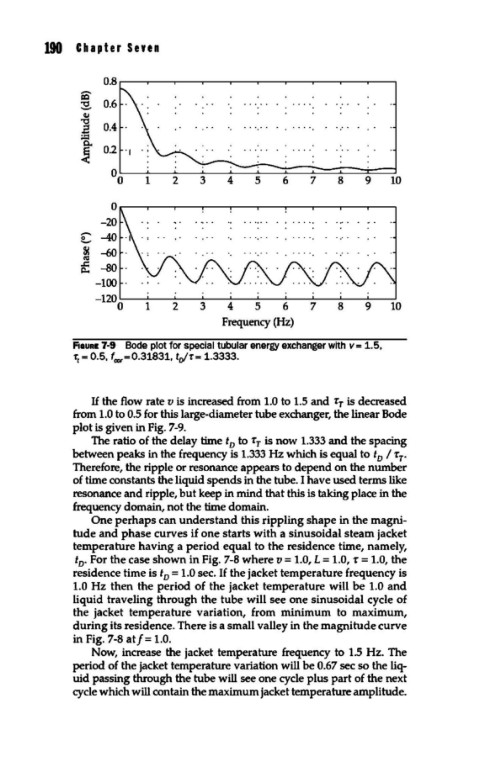
             fiGURE 7-9  Bode plot for special tubular energy exchanger with v = 1.5,
             rt = 0.5, fcor=0.31831, tofr= 1.3333.


                If the flow rate v is increased from 1.0 to 1.5 and r 1  is decreased
             from 1.0 to 0.5 for this large-diameter tube exchanger, the linear Bode
             plot is given in Fig. 7-9.
                The ratio of the delay time t to T 1  is now 1.333 and the spacing
                                       0
             between peaks in the frequency is 1.333 Hz which is equal to t I -r .
                                                               0   1
             Therefore, the ripple or resonance appears to depend on the number
             of time constants the liquid spends in the tube. I have used terms like
             resonance and ripple, but keep in mind that this is taking place in the
             frequency domain, not the time domain.
                One perhaps can understand this rippling shape in the magni-
             tude and phase curves if one starts with a sinusoidal steam jacket
             temperature having a period equal to the residence time, namely,
             t • For the case shown in Fig. 7-8 where v = 1.0, L = 1.0, 'r = 1.0, the
              0
             residence time is t = 1.0 sec. If the jacket temperature frequency is
                            0
             1.0 Hz then the period of the jacket temperature will be 1.0 and
             liquid traveling through the tube will see one sinusoidal cycle of
             the  jacket  temperature  variation,  from  minimum  to  maximum,
             during its residence. There is a small valley in the magnitude curve
             in Fig. 7-8 atf= 1.0.
                Now, increase the jacket temperature frequency to 1.5 Hz. The
             period of the jacket temperature variation will be 0.67 sec so the liq-
             uid passing through the tube will see one cycle plus part of the next
             cycle which will contain the maximum jacket temperature amplitude.

