


Page 220 - Practical Control Engineering a Guide for Engineers, Managers, and Practitioners
P. 220
194  Chapter  Seven

                 1.4 r-.........,..-~-~---"'T"----r--~~---;:=t::=:.====;J
                                                      -Steam  T
                                                      ..  OutletT
                 1.2
                                                      - Setpoint
                   1~-----.~  ..  ~.----------------------------~


                 0.8

                 0.6                        P = 1  I= 10  D = 0

                 0.4

                 0.2 ~

                   0
                    0   0.2  0.4  0.6  0.8   1   1.2  1.4  1.6  1.8   2
                                        Time

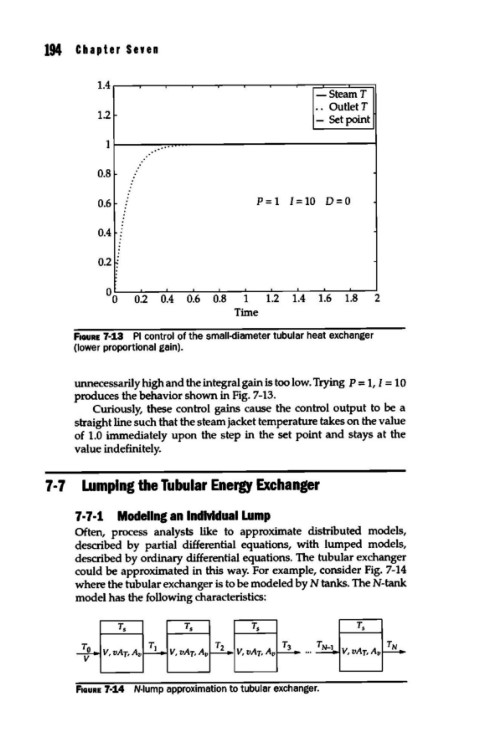
             FIGURE  7-13  PI control of the small-diameter tubular heat exchanger
             (lower proportional gain).

             unnecessarily high and the integral gain is too low. Trying  p = 1, I = 10
             produces the behavior shown in Fig. 7-13.
                Curiously, these control gains cause the control output to be a
             straight line such that the steam jacket temperature takes on the value
             of 1.0 immediately upon the step in the set point and stays at the
             value indefinitely.


         7  •  7  Lumping the Tubular Energy Exchanger

             7  ·  7  ·1  Modeling an Individual Lump
             Often,  process  analysts  like  to  approximate  distributed  models,
              described  by  partial  differential  equations,  with  lumped  models,
              described by ordinary differential equations. The tubular exchanger
              could be approximated in this way. For example, consider Fig. 7-14
              where the tubular exchanger is to be modeled by N tanks. TheN-tank
              model has the following characteristics:


              FIGURE 7-14  N-lump approximation to tubular exchanger.

