


Page 219 - Practical Control Engineering a Guide for Engineers, Managers, and Practitioners
P. 219
Distributed  Processes   193


             going to key on. The dynamics of the slave loop are considered to be
             so much faster than those of the liquid temperature control loop that
             they can be neglected. This master I slave configuration is a cascade
             control structure and will be dealt with in Chap. 11.
                At time zero, the step in the set point causes the proportional
             component of the control algorithm  to jump to 3.0  (which  makes
             sense because the proportional gain is 3.0). As the outlet temperature
             starts to respond, the proportional component backs off. At t = 1.0 the
             initial  contents  of  the  tube  have  passed  through  the  exchanger.
             Although there is a delay for the liquid to pass through the tube, all
             of the liquid sees the step in the jacket temperature immediately so
             there is no dead-time effect. For t > 1. 0 the tube will contain material
             that has entered the exchanger after the set point was stepped and the
             outlet temperature will back off slightly with an associated response
             of the proportional component. All this time, the integral component
             has been slowly working to bring the outlet temperature near the set
             point. The reader can try other control gain combinations by modify-
             ing the Matlab script that generated Fig. 7-11.
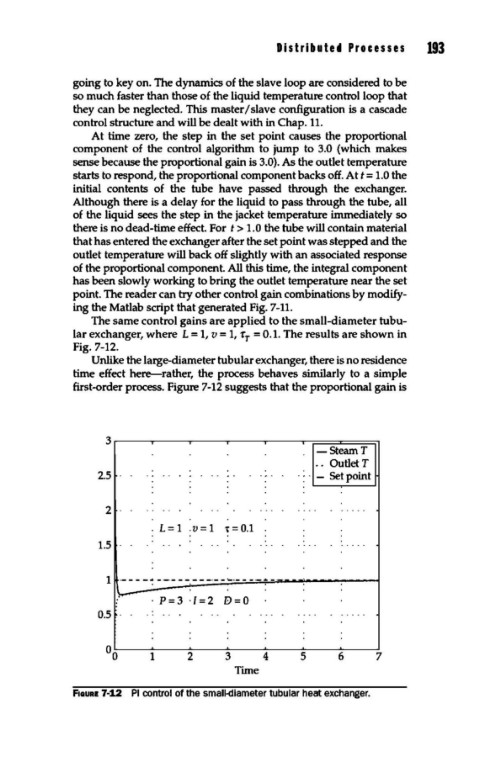
                The same control gains are applied to the small-diameter tubu-
             lar exchanger, where L = 1, v = 1, rr = 0.1. The results are shown in
             Fig. 7-12.
                Unlike the large-diameter tubular exchanger, there is no residence
             time effect here-rather, the process behaves similarly to a  simple
             first-order process. Figure 7-12 suggests that the proportional gain is


                  3r---,---.----.----.----~==~==~
                                                     -Steam T
                                                   0
                                                     ..  OutletT
                 2.5                              0  :  0   -  Set point

                  2
                           L = 1  ° v = 1  t  = 0.1
                 1.5


                   1  --- - - ...  - - -- -- --- - -·- - - • -
                    ~0 0
                          o  P = 3  I = 2  E> = 0
                    ;·          o
                 0.5


                          1     2     3      4     5     6     7
                                        Time
             F1aURE 7-12  PI  control of the small-diameter tubular heat exchanger.

