


Page 218 - Practical Control Engineering a Guide for Engineers, Managers, and Practitioners
P. 218
192  Chapter  Seven

             which would have periods of 10.0 sec or more, there appears to be no
             resonance because the amplitude is nearly unity. This suggests that
             for these low frequencies, the  jacket temperature variations are passed
             through the tube unattenuated. Thus, for low jacket temperature fre-
             quencies, the tube is long enough to cause the outlet temperature to
             have the same amplitude as the jacket temperature.


        7-6  Control of the Tubular Energy Exchanger
             The open loop step-change response and the Bode plot suggest that there
             should not be too much trouble if  feedback control is attempted. The
             large-diameter tubular energy exchanger has some idiosyncrasies but
             the total phase lag varies about 90° (why?-because, despite the dis-
             tributed nature of the process, it is still basically first order).
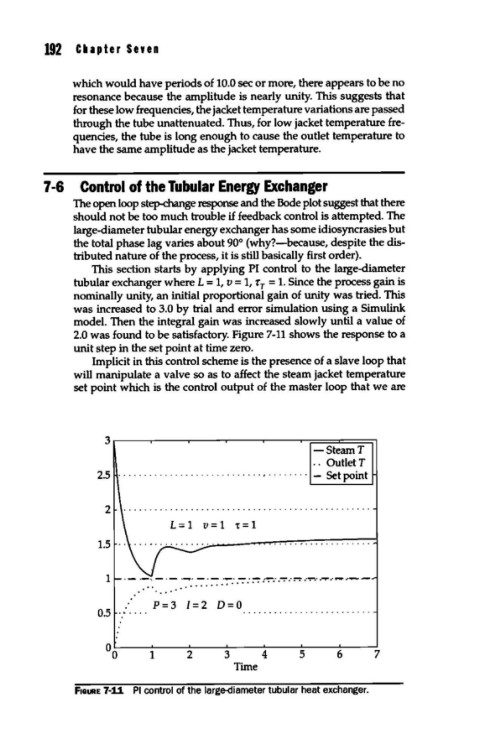
                This section starts by applying PI control to the large-diameter
             tubular exchanger where L = 1, v = 1, rr = 1. Since the process gain is
             nominally unity, an initial proportional gain of unity was tried. This
             was increased to 3.0 by trial and error simulation using a Simulink
             model. Then the integral gain was increased slowly until a value of
             2.0 was found to be satisfactory. Figure 7-11 shows the response to a
             unit step in the set point at time zero.
                Implicit in this control scheme is the presence of a slave loop that
             will manipulate a valve so as to affect the steam jacket temperature
             set point which is the control output of the master loop that we are


                   3r---~--~----~--~----~==~==~
                                                     -SteamT
                                                     ..  OutletT
                 2.5   0   0   0   0   0   0   0   0   0   0   0   0   0   0   0   0   0   0   0   °   0   0   0   0   0   0   0   0   ,   0   0   °   0   0   0   0   0   _   Set point

                  2
                             L=1  v=1  t=1


                   1
                                .•·•••••r
                          P=3  1=2  D=O
                 0.5  -· ....


                          1     2     3      4     5     6     7
                                        Time
             F1auRE 7-11  PI  control of the large-diameter tubular heat exchanger.

