


Page 221 - Practical Control Engineering a Guide for Engineers, Managers, and Practitioners
P. 221
Distributed  Processes   195


                 1.  Each  tank  is  completely  mixed  in  the  sense  that  the  exit
                   temperature is the same as the temperature throughout the
                   lump or tank. These lumps are often called continuous stirred
                   tanks (CSTs).
                 2.  Each tank is jacketed and is exposed to the jacket temperature
                   ~· Although this need not be case in general, each tank sees
                   the same jacket temperature. That is, the jacket temperature
                   does not vary from tank to tank.
                 3.  The temperature leaving the kth tank is the inlet temperature
                   for the k+  1  th tank.
                 4.  Parameterwise, each tank is identical. This is not necessary
                   but it does make the mathematics more manageable.

                The mixing in each lump, mentioned in condition 1, will change
             the  propagation  of  step  changes  significantly.  The  relationship
             between the number of lumps and the degree of axial mixing (or axial
             diffusion) will be examined later.
                A dynamic energy balance over the kth tank yields the following:

                In from (k- 1)th tank:  vAvCppTk-t
                Out from kth tank:  vAvCppTk
                Into the kth tank from steam jacket:  UAr(Ts- Tk)
                Accumulation in kth tank:  VC,p dt
                                           dT.

                Where ~  is the cross-sectional area for flow into and out of the
             tank, Ar is the transfer area between the jacket and the tank, and V is
             the volume of the tank.
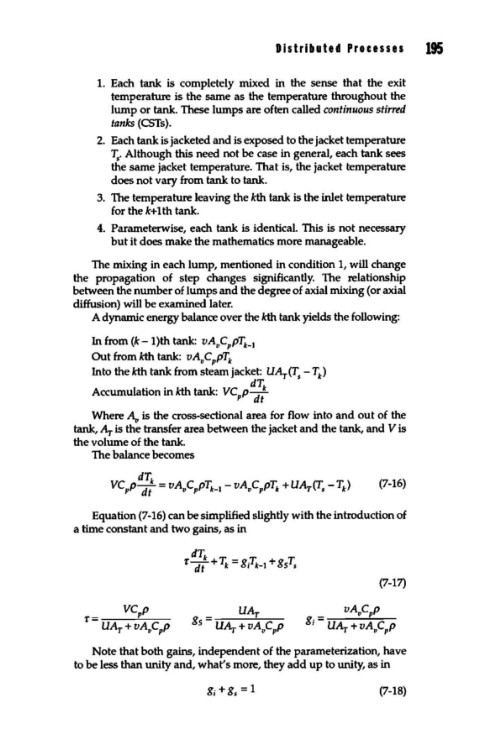
                The balance becomes


                Equation (7-16) can be simplified slightly with the introduction of
             a time constant and two gains, as in


                                                                (7-17)

                                                      _   vAvCpp
                                                    K; - UAr +  vAvCpp

                Note that both gains, independent of the parameterization, have
             to be less than unity and, what's more, they add up to unity, as in

                                   K; + Ks  = 1                 (7-18)

