


Page 537 - Practical Design Ships and Floating Structures
P. 537
512

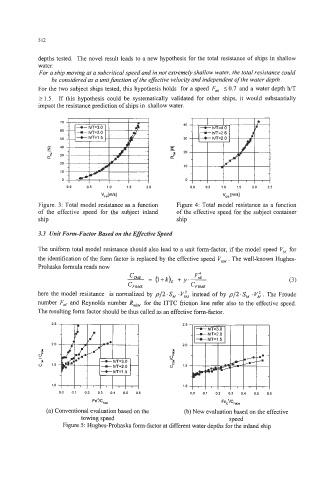
            depths tested.  The novel result leads to a new hypothesis for the total resistance of ships in shallow
            water:
            For a ship moving at a subcritical speed and in not extremely shallow water, the total resistance could
                be considered as a unitfirnction of the effective velocity and independent of the water depth .
            For the two subject ships tested, this hypothesis holds  for a speed Fnh 50.7 and a water depth h/T
            2 1.5.  If  this  hypothesis could  be  systematically validated  for other ships,  it  would  substantially
            impact the resistance prediction of ships in  shallow water.


                  70
                  60
               -   50                             -
               z
                  40
               I                                  +.
               d   30                             aF
                  20
                  10
                   0
                    00    0.5   1.0   1.5   2.0         0.0   0.5   1.0   1.5   2.0   2.5
                              VE.IW                              v,,   WSI
            Figure. 3: Total model resistance as a function   Figure 4: Total model resistance as a function
            of  the  effective  speed  for  the  subject  inland   of the effective speed for the subject container
            ship                                    ship

            3.3  Unit Form-Factor Based on the Effective Speed
            The uniform total model resistance should also lead to a unit form-factor, if the model speed VM for
            the identification of the form factor is replaced by the effective speed VEM . The well-known Hughes-
            Prohaska formula reads now
                                                                                    (3)
                                                        LFOME
            here the model resistance  is normalized by  p 12. S,  . V&  instead of by  p/2. S,  . Vi . The Froude
            number  FnE and Reynolds number  R,  for the ITTC friction line refer also to the effective speed.
            The resulting form factor should be thus called as an effective form-factor.
                                                      2.5


                                                      2.0
             1
            YL
             E
            0

                                                      1.0
                  0.0   0.1   0.2   0.3   0.4   0.5   0.6   00   0.1   0.2   0.3   0.4   0.5   0.6
                            Fn'/CF,
                                                                 FnE'/CFaM
              (a) Conventional evaluation based on the   (b) New evaluation based on the effective
                        towing speed                               speed
                   Figure 5: Hughes-Prohaska form-factor at different water depths for the inland ship

