


Page 538 - Practical Design Ships and Floating Structures
P. 538
513


     4  RESISTANCE PREDICTION
     Considering the special feature of the model resistance as a unit function of the effective speed, the
     conventional prediction of the ship resistance by  means  of the common form-factor method can be
     demonstrated as follows:
        Estimating the model wave resistanceR,  (Vm) as a function of the effective speed  vEM
             Rw (Vm) = R,  (Vm 1- R,  YE,)  = Rm (V. )-(I  + k)ECFom ,%P,  .SA.+ .V,&   (4)
        with the ITTC friction line C,,,   =  O.O75/(log  R,,,-2)2   for a Reynolds number corresponding
        to the effective speed at model scale  R,,   =  VEM . L,  /v,  ;
        Evaluating the ship speed  V, = V, fi as well as the effective speed VEs = Vm fi ;
        Predicting the ship resistance at the corresponding water-depth tested
              R,  (vs) = R,  WE,>  + ~ws (vEs) = [(I + k)ECFoEs + C, IXPSV,A + ~/~uRwnra~  (5)
        with the ITTC friction line CF0, =  O.O75/(log  R,,-2)2  and for the effective Reynolds number at
        the full scale R,,   =  VEs L,/vs  ;
        Predicting the ship resistance at the water-depth h/T=Prediction from the available model test
        h/T=Test:
                        -
        [~m (G )lm=Prediction  -  IR, (v, )lhm=PWiction   +  RWSh/T=Tesl ('ESJm=predldon
                                                                             . (6)
                        =  [(l+ k)E  ' cFO€S   ' ,% P '   ' V,$]M=Prediction   +  P'PM  [RW ]M=Test  '
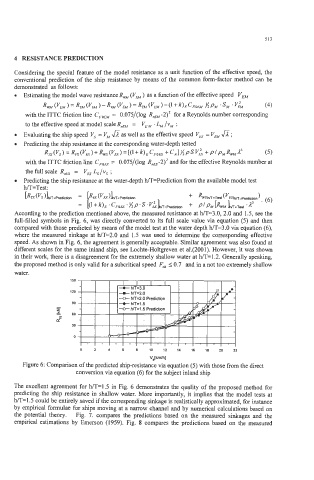
     According to the prediction mentioned above, the measured resistance at h/T=3.0, 2.0 and 1.5, see the
     full-filled symbols in Fig. 6, was directly converted to its full scale value via equation (5) and then
     compared with those predicted by means of the model test at the water depth h/T=3.0 via equation (6),
     where the measured sinkage at h/T=2.0 and  1.5 was used  to  determine the corresponding effective
     speed. As shown in Fig. 6, the agreement is generally acceptable. Similar agreement was also found at
     different scales for the same inland ship, see Lochte-Holtgreven  et al.(2001). However, it was shown
     in their work, there is a disagreement for the extremely shallow water at h/T=l.2. Generally speaking,
     the proposed method is only valid for a subcritical speed Fnh 50.7  and in a not too extremely shallow
     water.
                     150
                     120
                 -    90           -e-   h17'-2  0 Prediction
                 5    60
                 8"
                      30
                      0
                        I  '  1 I , 1 ( 1 ( 1 , 1 ( 1 , 1 1 1 , 1 , 1 , ~
                        0   2   4   6   8   10   12   14   16   18   20   22
                                            V,[km/h]
        Figure 6: Comparison of the predicted ship-resistance via equation (5) with those from the direct
                       conversion via equation (6) for the subject inland ship

     The excellent agreement for h/T=1.5  in Fig. 6 demonstrates the quality of the proposed method for
     predicting  the ship resistance in shallow water. More importantly, it implies that the model tests at
     h/T=l.5 could be entirely saved if the corresponding sinkage is realistically approximated, for instance
     by  empirical formulae for ships moving at a narrow channel and by numerical calculations based on
     the  potential  theory.   Fig.  7.  compares the  predictions based  on the  measured  sinkages and  the
     empirical  estimations by  Emerson (1959). Fig.  8  compares the predictions based on the measured

