


Page 540 - Practical Design Ships and Floating Structures
P. 540
515


     Physically, the wave effect included in the effective speed is less important or may be not reasonable
     for the propulsion characteristics behind the ship. However, due to possible errors in the measurements
     for one specific ship, this hypothesis has to be proved by analyzing measurements of other ships.
          70                                  70
          60                                  60
          50                                  50
      3   40                              E   40
      a   30                              n   30
                                           1
       1
          20                                  20
          10                                  10
           0                                  0
            00   05   10   15   20   25         00   0.5   1.0   1.5   2.0   2.5
                     v,,I~/~I                            V,,[m'SI
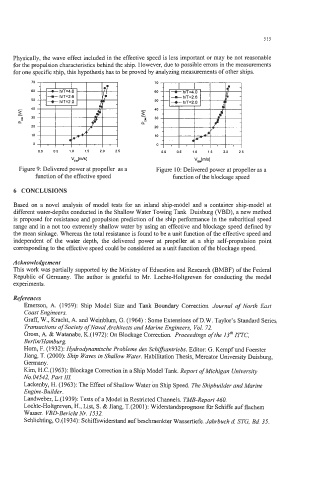
      Figure 9: Delivered power at propeller as a   Figure 10: Delivered power at propeller as a
           function of the effective speed         function of the blockage speed

     6  CONCLUSIONS
     Based  on a novel  analysis of model tests for an inland ship-model and a  container ship-model  at
     different water-depths conducted in the Shallow Water Towing Tank  Duisburg (VBD), a new method
     is proposed for resistance and propulsion prediction of the ship performance in the subcritical speed
     range and in a not too extremely shallow water by using an effective and blockage speed defined by
     the mean sinkage. Whereas the total resistance is found to be a unit function of the effective speed and
     independent of  the  water  depth,  the  delivered power  at  propeller at  a  ship  self-propulsion point
     corresponding to the effective speed could be considered  as a unit function of the blockage speed.

     Acknowledgement
     This work was partially supported by the Ministry of Education and Research (BMBF) of the Federal
     Republic of Germany. The author is  grateful to  Mr. Lochte-Holtgreven for  conducting the  model
     experiments.

     References
        Emerson, A.  (1959): Ship Model Size and Tank  Boundary Correction  Journal  of  North East
        Coast Engineers.
        Graff, W., Kracht, A. and Weinblum, G. (1964) : Some Extensions of D.W. Taylor's Standard Series,
        Transactions of Society of  Naval Architects and Marine Engineers, Vol. 72.
        Gross, A. & Watanabe, K.(1972): On Blockage Correction  Proceedings of  the 13'h lTTC,
        BerlidHamburg.
        Horn, F. (1932): Hydrodynamische Probleme des Schiffsantriebs. Editor: G. Kempf und Foerster
        Jiang, T. (2000): Ship Waves in Shallow Water. Habilitation Thesis, Mercator University Duisburg,
        Germany.
        Kim, H.C.(1963): Blockage Correction in a Ship Model Tank. Report of Michigan University
        No. 04542, Part III.
        Lackenby, H. (1963): The Effect of Shallow Water on Ship Speed The Shipbuilder and Marine
        Engine-Builder.
        Landweber, L.( 1939): Tests of a Model in Restricted Channels. TMB-Report 460.
        Lochte-Holtgreven, H., List, S. & Jiang, T.(2001): Widerstandsprognose fiir Schiffe auf flachem
        Wasser. VBD-Bericht Nr. 1532.
        Schlichting, O.( 1934): Schiffswiderstand auf beschraenkter Wassertiefe. Jahrbuch d. STG, Bd. 35.

