


Page 544 - Practical Design Ships and Floating Structures
P. 544
519

       like material, whereas if the surface was too wet, the gauge skidded very easily; both practices would
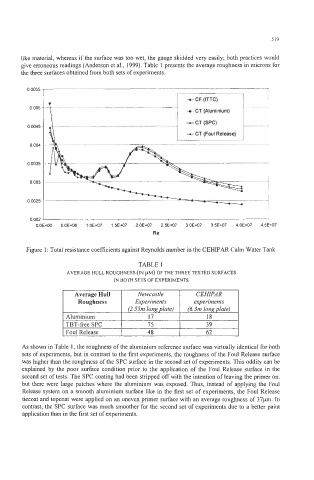
       give erroneous readings (Anderson et al., 1999). Table 1 presents the average roughness in microns for
       the three surfaces obtained from both sets of experiments.


         0 0045
                                                       - CT (Foul Release)
          0 004

         0.0035

          0 003


         0.0025


           O.OE+OO   5.OE+06   1 .OE+07   1.5E+07   2.OE+07   2.5E+07   3.OE+07   3.5E+07   4.OE+07   4.5E+07
                                             Re

         Figure 1 : Total resistance coefficients against Reynolds number in the CEHIPAR Calm Water Tank

                                         TABLE 1
                    AVERAGE HULL ROUGHNESS (IN FM) OF THE THREE TESTED SURFACES
                                  IN BOTH SETS OF EXPERIMENTS
                       Average Hull      Newcastle        CEHIPAR
                        Roughness                        experiments
                    Aluminium
                    TRT-free SPC            75               39
                   I Foul Release           48               62

       As shown in Table 1, the roughness of the aluminium reference surface was virtually identical for both
       sets of experiments, but in contrast to the first experiments, the roughness of the Foul Release surface
       was higher than the roughness of the SPC surface in the second set of experiments. This oddity can be
       explained by  the poor surface condition  prior to the application  of the Foul  Release surface  in  the
       second set of tests. The SPC coating had been stripped off with the intention of leaving the primer on,
       but there were large patches  where the aluminium was exposed. Thus,  instead of applying the  Foul
       Release system on a smooth aluminium surface like in the first set of experiments, the Foul Release
       tiecoat and topcoat were applied on an uneven primer surface with an average roughness of 37pm. In
       contrast, the SPC surface was much smoother for the second set of experiments due to a better paint
       application than in the first set of experiments.

