


Page 547 - Practical Design Ships and Floating Structures
P. 547
522


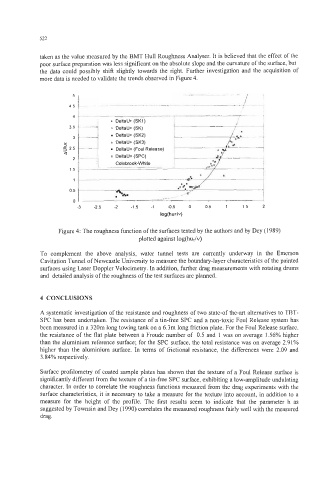
            taken as the value measured by the BMT Hull Roughness Analyser. It is believed that the effect of the
            poor surface preparation was less significant on the absolute slope and the curvature of the surface, but
            the  data could  possibly  shift  slightly  towards  the  right.  Further  investigation  and  the  acquisition  of
            more data is needed to validate the trends observed in Figure 4.


                                 0  DeRaU+ (SK)
                                  DeltaU+ (SK2)
                                 a  DeltaU+ (SK3)
                                 =  DeitaU+ (Foul Release)


                       -3   -25   -2   -15   -1   -05   0   05    1    15    2
                                               log(hur/v)

                  Figure 4: The roughness function of the surfaces tested by the authors and by Dey (1 989)
                                         plotted against log(hu,/v)

             To  complement  the  above  analysis,  water  tunnel  tests  are  currently  underway  in  the  Emerson
             Cavitation Tunnel of Newcastle University to measure the boundary-layer characteristics of the painted
             surfaces using Laser Doppler Velocimetry. In addition, further drag measurements with rotating drums
             and  detailed analysis of the roughness of the test surfaces are planned.


             4  CONCLUSIONS

             A systematic investigation of the resistance and roughness of two state-of the-art alternatives to TBT-
             SPC has been undertaken.  The resistance of a tin-free  SPC and a non-toxic Foul Release system has
             been measured in a 320m long towing tank on a 6.3m long friction plate. For the Foul Release surface,
             the resistance of the flat plate between a Froude number of  0.5  and  1 was on average  1.56% higher
             than the aluminium reference surface; for the SPC surface, the total resistance was on average 2.91%
             higher  than  the  aluminium  surface.  In  terms of frictional  resistance,  the differences  were  2.09  and
             3.84% respectively.
             Surface profilometry of coated sample plates has shown that the texture of a Foul Release  surface is
             significantly different from the texture of a tin-free SPC surface, exhibiting a low-amplitude undulating
             character. In order to correlate the roughness functions measured from the drag experiments with the
             surface characteristics, it is necessary to take a measure for the texture into account, in addition to a
             measure  for  the  height  of  the  profile.  The  first  results  seem  to  indicate  that  the  parameter  h  as
             suggested by Townsin and Dey (1 990) correlates the measured roughness fairly well with the measured
             drag.

