


Page 551 - Practical Design Ships and Floating Structures
P. 551
526

              All of the symbols are used accordiig to the ISOlDIS 15016 and ITTC standard symbols.


              2  SPEED TRIAL ANALYSIS PROCEDURE OF ISO/DIS 15016

              The analysis procedure of ISO/DIS 15016 is divided into six steps. This analysis procedure is based on
              Taniguchi-Tamura’s  Method  (Taniguchi  etc.,  1966).  Various calculation  methods  of  resistance
              increase due to the disturbances and the deviations are suggested to use at annex of ISODIS 16016. In
              this guideline, it has described that the methods presented in the annexes are the latest one available
              today,  other scientifically-based method  including model  tests may  be  adopted as agreed between
              shipyard and ship owner.
              Calculation of resistance increase due to waves is divided into two stages. One is pre-calculation of
              response function of  added  resistance  in  regular  waves prior  to  speed  trials.  The  other  is  main
              calculation to be made on board for particular irregular waves during trials. When both seas and swell
              are observed and are to be taken into account,  the tot4 resistance increase is given by the sum of
              resistance increase due to  seas and  swell calculated independently.  The  calculation of  resistance
              increase due to waves is based  on Maruo’s formula (Maruo,  1960).  In short waves, diffraction of
              incident waves  is observed around the bow,  and this causes the main  resistance in waves.  As the
              correction of this effect, Faltinsen’s formula (Faltinsen etc., 1980), Kwon’s formula (Kwon, 1982) and
              Fujii-Takahashi’s formula (Fujii  etc.,  1975) are suggested to use.  For the resistance increase due to
              waves,  the  Townsin-Kwon’s  method  (Townsin  etc.,  1993)  is  suggested to  use  also.  When  the
              calculation of resistance increase of ships in irregular waves, ITTC standard spectrum and JONS WAP
              spectrum are respectively used for the frequency distribution of incident waves for seas and swell.
              The analysis method of resistance increase due to  wind  is  suggested to use.  The wind resistance
              coefficients should be based on data which is derived from model tests in wind tunnel or test resuits of
               similar ship. The formula for resistance increase due to steering required by come keeping and the
               formula of resistance increase due to drifting are suggested to use. For speed loss due to shallow water,
               the Lackenby’s formula (Lackenby, 1963) is suggested to use also.

               3  COMPUTER PROGRAM OF SPEED TRIAL ANALYSIS

               The  flowchart  of  analysis program  is  shown  in  Figure  1.  All  of  the  suggested methods  from
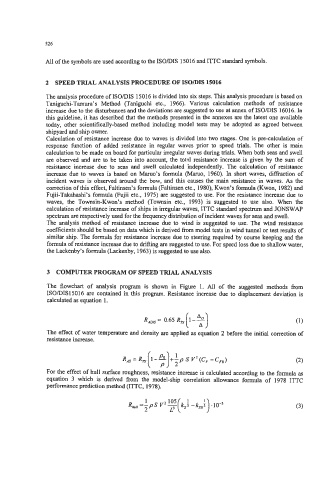
               ISO/DIS15016 are contained in this program.  Resistance increase due to displacement deviation is
               calculated as equation 1.
                                                       i 3
                                           R,,  = 0.65 R,  1-0
               The effect of water temperature and density are applied as equation 2 before the initial correction of
               resistance increase.
                                            i 3:
                                     R,  = R,  1--   +-p  S V2 (C, -C,,)
                                            .  -.
               For the effect of hull surface roughness, resistance increase is calculated according to the formula as
               equation  3 which  is  derived  from  the  model-ship correlation allowance  formula  of  1978  ITTC
               performance prediction method (ITTC, 1978).

                                      R, =-pS  V2 E(k,f  -k,,f)  .lo-’                 (3)
                                           1
                                           2      L3

