


Page 553 - Practical Design Ships and Floating Structures
P. 553
528


            For the wind resistance coefficients, the JTTC standard curve and twenty-two Blendermann’s curves
            can  be  selected as an  option (Blendermann, 1991). It  needs  lots of  interpolation routines in  this
            program. Table 1 shows various interpolation methods used in this program. The computer program is
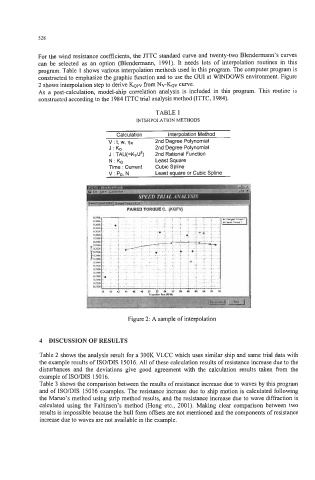
            constructed to emphasize the graphic function and to use the GUI at WINDOWS environment. Figure
            2 shows interpolation step to derive KQFV from Nv-KQv curve.
            As  a post-calculation, model-ship correlation analysis is  included in this program. This routine is
            constructed according to the 1984 ITTC trial analysis method (ITTC, 1984).

                                              TABLE 1
                                         INTERPOLATION METHODS

                                   Calculation    Interpolation Method
                                v  t, w, T)R   2nd Degree Polynomial
                                J:KQ          2nd Degree Polynomial
                                J : TAU(=KT/Jz)   2nd Rational Function
                                 N: KQ        Least Square
                                Time : Current   Cubic Spline
                                V  PD, N      Least square or Cubic Spline


                                      FAIRED TORQUE C. (KQFV)


                                      Figure 2: A sample of interpolation


            4  DISCUSSION OF RESULTS
            Table 2 shows the analysis result for a 300K VLCC which uses similar ship and same trial data with
            the example results of ISO/DIS 15016. All of these calculation results of resistance increase due to the
            disturbances and  the  deviations give  good  agreement with  the  calculation results  taken  from  the
            example of ISODIS 15016.
            Table 3 shows the comparison between the results of resistance increase due to waves by this program
            and of ISO/DIS  15016 examples. The resistance increase due to ship motion is calculated following
            the Maruo’s method using strip method results, and the resistance increase due to wave diffraction is
            calculated  using the  Faltinsen’s method  (Hong etc., 2001).  Making clear comparison between  two
            results is impossible because the hull form offsets are not mentioned and the components of resistance
            increase due to waves are not available in the example.

