


Page 545 - Practical Design Ships and Floating Structures
P. 545
520

             If one compares Table  1 with Figure 1, one notices immediately that the resistance of a surface coated
             with a Foul Release system does not correlate with the roughness parameter Rt50.
             Consequently,  a UBM  optical measurement  system was used  to analyse small  sample plates  (20 by
             25cm) coated with the two paint systems described in the previous  section. The instrument works by
             the  focus-detection  principle  whereby the  vertical  displacement  of  the  objective  is  measured  by  an
             infrared laser diode as light source. The instrument has a vertical range of 0.5mm and a resolution of
             less than 50nm.
             The roughness  of  the  surfaces  has  been  investigated  by  analysing a  wide  range  of parameters.  The
             amplitude  parameters,  characterising how the roughness  varies at right  angles to the surface, can be
             subdivided  into extreme-value parameters  (e.g. Rt),  average parameters  and properties  of the height
             distribution. Texture parameters, which describe how the roughness varies in the plane of the surface,
             included counts of extrema and crossings with the mean line, the average absolute slope Sa, and the
             correlation  length  T. A  fractal approach,  which  essentially  scrutinises  the  surface  for self-similarity,
             was included by computing the fractal dimension.
             The measurements were carried  out for a range of long wavelength  cut-offs and  sampling  intervals
             (equal  to  half  the  Nyquist  short wavelength  cut-oft).  In  accordance  to the  standards  for roughness
             measurement  as suggested by Medhurst  (1 990), 3 transversal  and 3 longitudinal  measurements were
             taken for each set of bandwidth parameters.

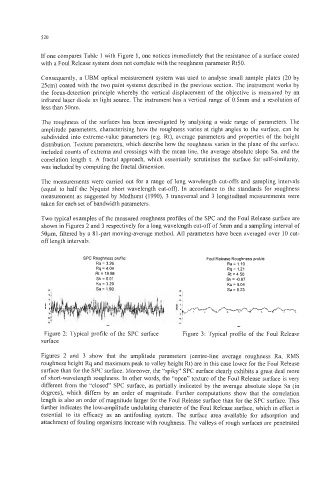
             Two typical examples of the measured roughness profiles of the SPC and the Foul Release surface are
             shown in Figures 2 and 3 respectively for a long wavelength cut-off of 5mm and a sampling interval of
             50pm, filtered by a 81-part moving-average method. All parameters have been averaged over  10 cut-
             off length intervals.

                         SPC Roughness profile:              Foul Release Roughness profile:
                             Ra = 3.26                             Ra= 1.10
                             Rq = 4.04                             Rq=1.21
                             Rt = 19.98                            Rt = 4.50
                             Sk = 0.01                             Sk = -0.87
                             KU  = 3.29                            Ku = 5.04
                             Sa = 1.90                             Sa = 0.23


                                -
               “I                                    I5 1             “.%
              Figure 2: Typical  profile of the  SPC surface   Figure 3:  Typical  profile  of the  Foul Release
             surface

             Figures  2  and  3  show  that  the  amplitude  parameters  (centre-line  average  roughness  Ra,  RMS
             roughness height Rq and maximum peak to valley height Rt) are in this case lower for the Foul Release
             surface than for the SPC surface. Moreover, the “spiky” SPC surface clearly exhibits a great deal more
             of short-wavelength roughness. In other words, the “open” texture of the Foul Release surface is very
             different  from the “closed”  SPC surface, as partially  indicated by the average absolute  slope Sa (in
             degrees),  which  differs  by  an  order  of magnitude.  Further  computations  show  that  the  correlation
             length is also an order of magnitude larger for the Foul Release surface than for the SPC surface. This
             further indicates the low-amplitude undulating character of the Foul Release surface, which in effect is
             essential  to  its  efficacy  as  an  antifouling  system.  The  surface  area available  for  adsorption  and
             attachment of fouling organisms increase with roughness. The valleys of rough surfaces are penetrated

