


Page 539 - Practical Design Ships and Floating Structures
P. 539
514

            sinkages and the numerical calculations by Jiang (2000) using an approximation based on the extended
            shallow-water theory.  For  the geometry configuration of the  VBD  towing tank the  agreement  is
            equally  remarkable for  both  sinkage estimations. However, since the numerical  estimation can  be
            applied for general shallow water cases, the combination of the proposed prediction method with the
            well-established  shallow-water approximation could be a new method for the resistance prediction of
            ships in shallow water.


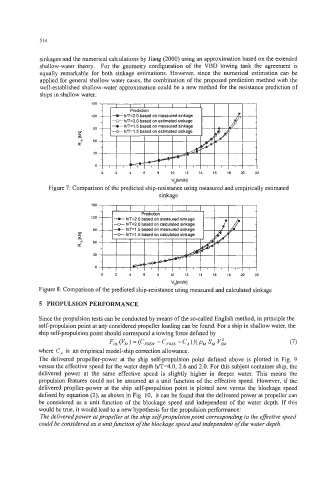
                                             on measured sinkage


                                                  VJkmlh]
               Figure 7: Comparison of the predicted ship-resistance using measured and empirically estimated
                                               sinkage

                           150
                           120
                       -    90
                       E
                       2    60

                            30
                            0
                              0   2   4   6   8   10   12   14   16   18   20   22
                                                  VJkWhl
            Figure 8: Comparison of the predicted ship-resistance using measured and calculated sinkage
            5 PROPULSION PERFORMANCE

            Since the propulsion tests can be conducted by means of the so-called English method, in principle the
            self-propulsion point at any considered propeller loading can be found. For a ship in shallow water, the
            ship self-propulsion point should correspond a towing force defined by
                                      ) = (‘FOEM  - ‘FOES  - ‘A  ) ,%  PM ‘M  ‘&
                                  ‘
                                  M
                                FDE  (                                               (7)

            where CA is  an empirical model-ship correction allowance.
            The delivered propeller-power at  the  ship self-propulsion point defined above is plotted in  Fig.  9
            versus the effective speed for the water depth h/T=4.0, 2.6 and 2.0. For this subject container ship, the
            delivered  power  at  the  same effective  speed  is  slightly higher  in  deeper  water.  This  means  the
            propulsion  features could not be assumed as a unit  function of the effective speed. However,  if the
            delivered propller-power at the ship self-propulsion point is plotted now versus the blockage speed
            defined by equation (2), as shown in Fig. 10,  it can be found that the delivered power at propeller can
            be  considered as a unit function of the blockage speed and independent of the water depth. If this
            would be true, it would lead to a new hypothesis for the propulsion performance:
             The delivered power at propeller at the ship self-propulsion point corresponding to the effective speed
            could be considered as a unitfinction of the blockage speed and independent of the water depth.

