


Page 179 - Practical Ship Design
P. 179
Volume, Ami cind Dimension-Bused Designs                            145

         Table 5.1
         Reasons for changes in manning.  1962-1976
                   ~~   ~      ~_______~~                    ~     ~   ~
         Cost reduction motives               Cost reduction means
             ~   ~~~~~    ~~~~~                                 ~~   ~~~~~
         Competition from aeroplanes to passenger ships   Improved machinery, requiring less attention and
         Competition from land routes to container ships   less maintenance
         Competition between shipping companies as many   Automation
         new nations enter the field          Use of self-lubricating fittings
         All of these leading to relatively, if not actually,   Cargo gear requiring less attention
         lower freight rate\                  Patent hatch covers with push-button operation
         Better job opportunities ashore leading to the   Self-tensioning winches, universal fdirleads, thrust
         necessity of paying higher wages and providing   units
         hetter conditions for seagoing personnel   Modern paint systems, modern plastic
         The enormous growth in shipping making the   accommodation linings
         acceptance of reduced manning politically acceptable   galley gear
                                             The use of work study
                                             The use of general purpose crews
                                                   ~__
                                                          ~~~~


         Table 5.2
         Change\  in manning  1962-1976  dnd expectation  in  1976 for tuture
                     ~~-                                  __      -~ -
             ~~~                  ~~       ~      ~~
         Ship type                     1962      1976                 Future
                                                 __    __     __~
                                       Typical   Typical   Automated   automated
                  ~     __     ~      ~      __~ ___  ~___          ~~    ___
         General cargo or bulk carrier   36      30        26         II
         Sophi\ticdted cargo liner or contdiner <hip   50   36   28   II
         Tanker                        45        36        26         9

         Future figures taken from B.V Keport  1976 by Monceaux “A look at the personnel of automated ships”


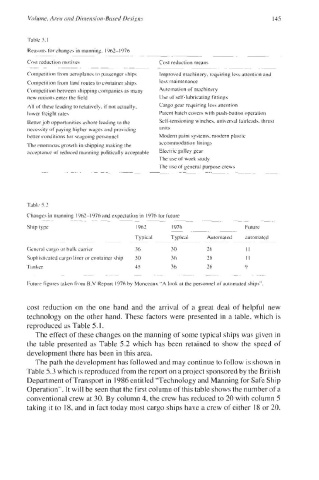
         cost  reduction  on  the  one hand  and the  arrival  of  a great  deal  of  helpful  new
         technology on the other hand. These factors were presented in a table, which is
         reproduced as Table 5.1.
           The effect of these changes on the manning of some typical ships was given in
         the table  presented  as Table 5.2 which has been retained  to show the  speed of
         development there has been in this area.
           The path the development has followed and may continue to follow is shown in
         Table 5.3 which is reproduced from the report on a project sponsored by the British
         Department of Transport in 1986 entitled “Technology and Manning for Safe Ship
         Operation”. It will be seen that the first column of this table shows the number of a
         conventional crew at 30. By column 4, the crew has reduced to 20 with column 5
         taking it to 18, and in fact today most cargo ships have a crew of either 18 or 20.

