


Page 232 - Pressure Swing Adsorption
P. 232
I  :_u  i
 .I   ill

 208   PRESSURE SWING ADSORPTION   DYNAMIC MODELING  OF A PSA SYSTEM   209

 a  small  throughout  ratw,  as  m  the  air  drying  experiments  (on  silica  gel)   Table 5.10.  Additional Equations for Nonisothermal PSA-SimulaUon Usmg LDF
 reported by Chihara and Suzuki.' These authors were the first  to mvest1gate   Approximation
 the  effect  of  nomsothermality  in  a  trace  component  PSA  system. 4   Later,
 9 12 15
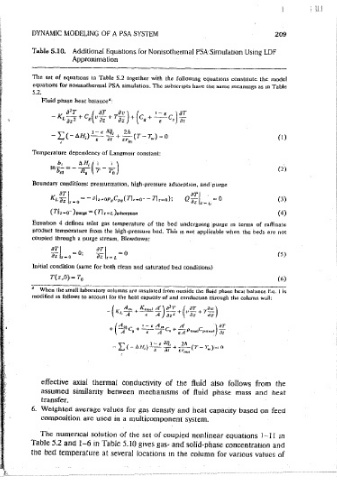
 Yang and co-workers •  •  showed that heat effects are even more detnmen-  The set  of equations  tn  Table  5.2  together with  the  followmg  equations  constitute  the  model
 tal  to  the  performance of equilibrium-controlled  bulk  seoarat1on  orocesses.   equatmns for nomsothermal PSA simulation. The subscnpts have the same meamngs as  in Table
         5.2.
 Nomsothennai studies have  further  revealed,  as  may  be  mtuitiveiy deduced,   Fluid phase heat baJancea·
 that  the  adia_batic  condition,  whicn  is  approached  m  a  large  commercial
 ooeration,  generally  results  in  the  worst  seoarat1on.  Whereas  for  many
 equilibrium-controlled separations,  the  isothermal  approximation  may mean
 a major departure from  physical  reality, this 1s  usually a  good approximation   (1)
 for  separations  based  on  kinetic  selectivity  smce  mass  transfer  rates  are
 generally much slower m such systems.   Temperature dependency of Langmuir constant:
 The  LDF model  discussed  m  Section  5.2  is  extended  here  to  allow  for
 nomsothermaJ  PSA  operation. The  additional  assumptions  are  summanzed   (2)
 and  the heat balance equations are given in Table 5.10.
         Boundary conditions: pressunzation,  high-pressure adsorPtion, and:purge
 1.  The equilibrmm  constants are  the most sensitive  temperature-dependent   KL ilz  z  _ = - d:r .. oPgCp 8 (Tl~-o- - Tl:r-o):   (3)
                •T1
 terms,  and  tt  1s  assumed  that  the  Langmmr  constants  show  the  normal   0
 exponential  temperature cteoendence (b = b e-AHJRT)_                (4)
 0
 2.  The  temperature  dependence  of  the  gas  and  solid  properlles  and  the   Equation  4  defines  inlet  gas  temperature  of the  bed  undergomg :purge  in  tenns  of  raffinate
 transoort parameters 1s  assumed  negligible.   product temperature from  the  high-pressure bed.  This  as  not  applicable when  the  beds are  not
         coupled  through a purge stream.  Slowdown:
 3.  Effective thermal conductivities of the commercrnl adsorbent particles are
 relatively high,  and  therefore  mtraparticle  temperature  gradients  can  be   arl   -o   (5)
                         -
 neglected.  Thermal  eauilibrmm  1s  assumed  between  the  fluid  and  the   i}z.  z-L -
 actsorbent particles, which  is  also a very common  assumot10n  m  adsorber   Initial condition (same  for  both dean and saturated bed conditions)
 calculattons~  60   T(z,O)~T  0                                      (6)
 4:  Bulk flow  of heat and conduction  in  the  axial  direction  are considered  in
           When the small laboratory columns are msuJated from ou1side  the fluid  phase heat  balance  Eq.  J i.~
 the heat balance eouation,  For heat conduction we consider the contribu-  modified as follows  to account  for  the  heat capacity of and conduction  through  the column wall:
 tion  from  axial  dispersion  only.  The  contribution  from  the  solid  phase   KAc•+KstcdA')i1 T  (OT  Tav)
                                           2
 becomes  important  at  low  Reynolds  number,  which  ts,  seldom,  if  ever,   -  (  1 -A  -.-A  Oz'+  l!Jz+-;;,
 approached  m  a  PSA  operation.  An  overall  heat  transfer  coefficient  is
 used  to  account  for  heat  loss  from  the  system.  The  temperature  of  the
 coiumn  wall  is  taken  to  be  eoual  to  that  of  the  feed.  Farooo  and
 Ruthven, 61 62   in their studies on heat effects m  adsorption column dynam-
 •
 ics, have shown that the maJor resistance to heat transfer m an adsorption
 colllmn is at the column wall, and a simple one-dimensional model with all
 heat  transfer resistance concentrated at  the column wall  orovides  a  good
 representation of the experimentally obseived behav10r. The advantage of   effective  axial  thermal  conductIVlty  of  the  fluid  also  follows  from  the
 using  the  one-dimenstonal  modeJ  is  that  the  system  behavior  at  the   assumed  similanty  between  mechanisms  of  fluid  phase  mass  and  heat
 isothermal and adiabatic limits may be very easily investigated by assignmg   transfer.
 a  large value  and  zero,  respectively,  to  the  beat transfer coefficient. The   6.  Weighted average values for gas density and  heat capacity based on  feed
 isothermal  condition  1s  also  approached  if the  simulation  is  carried  out   composition are used  in  a  multicomponent system.
 with  AH= 0.
 5.  The boundary conditions for the heat balance eouation are wntten assum-  The numerical solution  of the set of coupled nonlinear equations  1-J I m
 mg  the  heat-mass transfer anaiogy for a dispersed  plug flow  system.  The   Table 5.2 and 1-6 in Table 5.10 gives gas- and solid-phase concentration and
         the  bed  temoerature at several  locauons  m the coiumn  for  vanous values of

