


Page 497 - Refining Biomass Residues for Sustainable Energy and Bioproducts
P. 497
454                     Refining Biomass Residues for Sustainable Energy and Bioproducts

         20.3.2 Microalgae and macroalgae

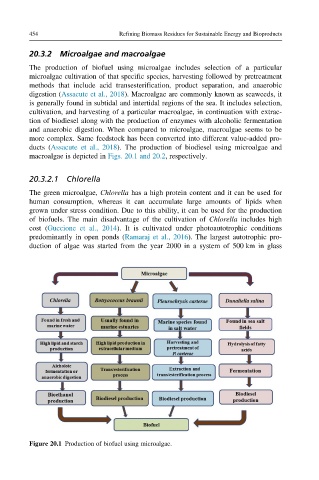
         The production of biofuel using microalgae includes selection of a particular
         microalgae cultivation of that specific species, harvesting followed by pretreatment
         methods that include acid transesterification, product separation, and anaerobic
         digestion (Assacute et al., 2018). Macroalgae are commonly known as seaweeds, it
         is generally found in subtidal and intertidal regions of the sea. It includes selection,
         cultivation, and harvesting of a particular macroalgae, in continuation with extrac-
         tion of biodiesel along with the production of enzymes with alcoholic fermentation
         and anaerobic digestion. When compared to microalgae, macroalgae seems to be
         more complex. Same feedstock has been converted into different value-added pro-
         ducts (Assacute et al., 2018). The production of biodiesel using microalgae and
         macroalgae is depicted in Figs. 20.1 and 20.2, respectively.


         20.3.2.1 Chlorella
         The green microalgae, Chlorella has a high protein content and it can be used for
         human consumption, whereas it can accumulate large amounts of lipids when
         grown under stress condition. Due to this ability, it can be used for the production
         of biofuels. The main disadvantage of the cultivation of Chlorella includes high
         cost (Guccione et al., 2014). It is cultivated under photoautotrophic conditions
         predominantly in open ponds (Ramaraj et al., 2016). The largest autotrophic pro-
         duction of algae was started from the year 2000 in a system of 500 km in glass


         Figure 20.1 Production of biofuel using microalgae.

