


Page 562 - Refining Biomass Residues for Sustainable Energy and Bioproducts
P. 562
512                     Refining Biomass Residues for Sustainable Energy and Bioproducts


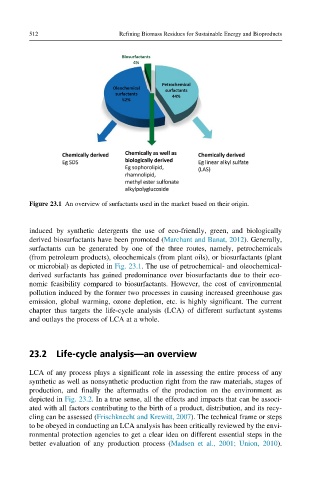
         Figure 23.1 An overview of surfactants used in the market based on their origin.


         induced by synthetic detergents the use of eco-friendly, green, and biologically
         derived biosurfactants have been promoted (Marchant and Banat, 2012). Generally,
         surfactants can be generated by one of the three routes, namely, petrochemicals
         (from petroleum products), oleochemicals (from plant oils), or biosurfactants (plant
         or microbial) as depicted in Fig. 23.1. The use of petrochemical- and oleochemical-
         derived surfactants has gained predominance over biosurfactants due to their eco-
         nomic feasibility compared to biosurfactants. However, the cost of environmental
         pollution induced by the former two processes in causing increased greenhouse gas
         emission, global warming, ozone depletion, etc. is highly significant. The current
         chapter thus targets the life-cycle analysis (LCA) of different surfactant systems
         and outlays the process of LCA at a whole.


         23.2   Life-cycle analysis—an overview

         LCA of any process plays a significant role in assessing the entire process of any
         synthetic as well as nonsynthetic production right from the raw materials, stages of
         production, and finally the aftermaths of the production on the environment as
         depicted in Fig. 23.2. In a true sense, all the effects and impacts that can be associ-
         ated with all factors contributing to the birth of a product, distribution, and its recy-
         cling can be assessed (Frischknecht and Krewitt, 2007). The technical frame or steps
         to be obeyed in conducting an LCA analysis has been critically reviewed by the envi-
         ronmental protection agencies to get a clear idea on different essential steps in the
         better evaluation of any production process (Madsen et al., 2001; Union, 2010).

