


Page 567 - Refining Biomass Residues for Sustainable Energy and Bioproducts
P. 567
516                     Refining Biomass Residues for Sustainable Energy and Bioproducts


         commonly used laundry detergents are often produced as a mixture or combinations
         of a wide array of surfactant molecules along with granular enzymes to increase
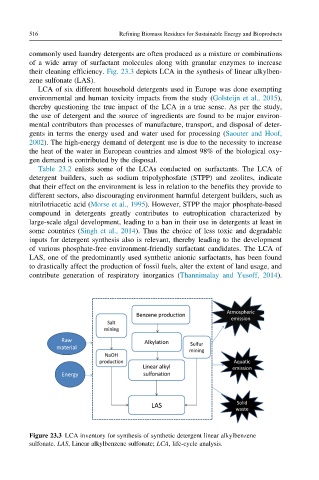
         their cleaning efficiency. Fig. 23.3 depicts LCA in the synthesis of linear alkylben-
         zene sulfonate (LAS).
           LCA of six different household detergents used in Europe was done exempting
         environmental and human toxicity impacts from the study (Golsteijn et al., 2015),
         thereby questioning the true impact of the LCA in a true sense. As per the study,
         the use of detergent and the source of ingredients are found to be major environ-
         mental contributors than processes of manufacture, transport, and disposal of deter-
         gents in terms the energy used and water used for processing (Saouter and Hoof,
         2002). The high-energy demand of detergent use is due to the necessity to increase
         the heat of the water in European countries and almost 98% of the biological oxy-
         gen demand is contributed by the disposal.
           Table 23.2 enlists some of the LCAs conducted on surfactants. The LCA of
         detergent builders, such as sodium tripolyphosfate (STPP) and zeolites, indicate
         that their effect on the environment is less in relation to the benefits they provide to
         different sectors, also discouraging environment harmful detergent builders, such as
         nitrilotriacetic acid (Morse et al., 1995). However, STPP the major phosphate-based
         compound in detergents greatly contributes to eutrophication characterized by
         large-scale algal development, leading to a ban in their use in detergents at least in
         some countries (Singh et al., 2014). Thus the choice of less toxic and degradable
         inputs for detergent synthesis also is relevant, thereby leading to the development
         of various phosphate-free environment-friendly surfactant candidates. The LCA of
         LAS, one of the predominantly used synthetic anionic surfactants, has been found
         to drastically affect the production of fossil fuels, alter the extent of land usage, and
         contribute generation of respiratory inorganics (Thannimalay and Yusoff, 2014).


         Figure 23.3 LCA inventory for synthesis of synthetic detergent linear alkylbenzene
         sulfonate. LAS, Linear alkylbenzene sulfonate; LCA, life-cycle analysis.

