


Page 569 - Refining Biomass Residues for Sustainable Energy and Bioproducts
P. 569
518                     Refining Biomass Residues for Sustainable Energy and Bioproducts


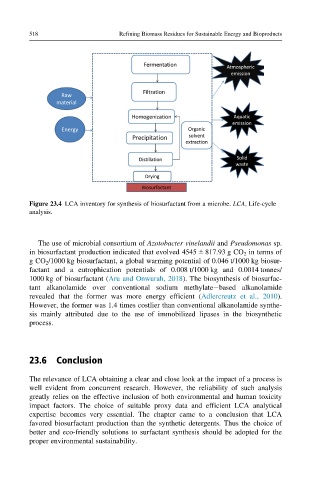
         Figure 23.4 LCA inventory for synthesis of biosurfactant from a microbe. LCA, Life-cycle
         analysis.


           The use of microbial consortium of Azotobacter vinelandii and Pseudomonas sp.
         in biosurfactant production indicated that evolved 4545 6 817.93 g CO 2 in terms of
         gCO 2 /1000 kg biosurfactant, a global warming potential of 0.046 t/1000 kg biosur-
         factant and a eutrophication potentials of 0.008 t/1000 kg and 0.0014 tonnes/
         1000 kg of biosurfactant (Aru and Onwurah, 2018). The biosynthesis of biosurfac-
         tant alkanolamide over conventional sodium methylate based alkanolamide
         revealed that the former was more energy efficient (Adlercreutz et al., 2010).
         However, the former was 1.4 times costlier than conventional alkanolamide synthe-
         sis mainly attributed due to the use of immobilized lipases in the biosynthetic
         process.


         23.6   Conclusion


         The relevance of LCA obtaining a clear and close look at the impact of a process is
         well evident from concurrent research. However, the reliability of such analysis
         greatly relies on the effective inclusion of both environmental and human toxicity
         impact factors. The choice of suitable proxy data and efficient LCA analytical
         expertise becomes very essential. The chapter came to a conclusion that LCA
         favored biosurfactant production than the synthetic detergents. Thus the choice of
         better and eco-friendly solutions to surfactant synthesis should be adopted for the
         proper environmental sustainability.

