


Page 568 - Refining Biomass Residues for Sustainable Energy and Bioproducts
P. 568
Comparative life-cycle analysis of synthetic detergents and biosurfactants—an overview  517


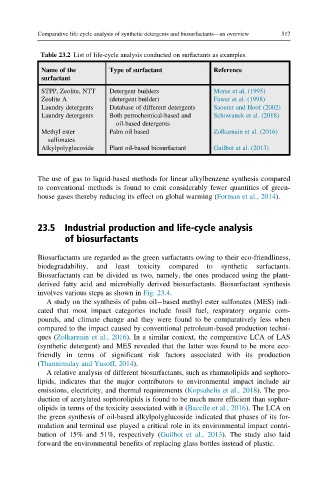
            Table 23.2 List of life-cycle analysis conducted on surfactants as examples.
            Name of the        Type of surfactant          Reference
            surfactant
            STPP, Zeolite, NTT  Detergent builders         Morse et al. (1995)
            Zeolite A          (detergent builder)         Fawer et al. (1998)
            Laundry detergents  Database of different detergents  Saouter and Hoof (2002)
            Laundry detergents  Both petrochemical-based and  Schowanek et al. (2018)
                                oil-based detergents
            Methyl ester       Palm oil based              Zolkarnain et al. (2016)
              sulfonates
            Alkylpolyglucoside  Plant oil-based biosurfactant  Guilbot et al. (2013)


           The use of gas to liquid-based methods for linear alkylbenzene synthesis compared
           to conventional methods is found to emit considerably fewer quantities of green-
           house gases thereby reducing its effect on global warming (Forman et al., 2014).


           23.5    Industrial production and life-cycle analysis
                   of biosurfactants

           Biosurfactants are regarded as the green surfactants owing to their eco-friendliness,
           biodegradability,  and  least  toxicity  compared  to  synthetic  surfactants.
           Biosurfactants can be divided as two, namely, the ones produced using the plant-
           derived fatty acid and microbially derived biosurfactants. Biosurfactant synthesis
           involves various steps as shown in Fig. 23.4.
              A study on the synthesis of palm oil based methyl ester sulfonates (MES) indi-
           cated that most impact categories include fossil fuel, respiratory organic com-
           pounds, and climate change and they were found to be comparatively less when
           compared to the impact caused by conventional petroleum-based production techni-
           ques (Zolkarnain et al., 2016). In a similar context, the comparative LCA of LAS
           (synthetic detergent) and MES revealed that the latter was found to be more eco-
           friendly in terms of significant risk factors associated with its production
           (Thannimalay and Yusoff, 2014).
              A relative analysis of different biosurfactants, such as rhamnolipids and sophoro-
           lipids, indicates that the major contributors to environmental impact include air
           emissions, electricity, and thermal requirements (Kopsahelis et al., 2018). The pro-
           duction of acetylated sophorolipids is found to be much more efficient than sophor-
           olipids in terms of the toxicity associated with it (Baccile et al., 2016). The LCA on
           the green synthesis of oil-based alkylpolyglucoside indicated that phases of its for-
           mulation and terminal use played a critical role in its environmental impact contri-
           bution of 15% and 51%, respectively (Guilbot et al., 2013). The study also laid
           forward the environmental benefits of replacing glass bottles instead of plastic.

