


Page 576 - Refining Biomass Residues for Sustainable Energy and Bioproducts
P. 576
526                     Refining Biomass Residues for Sustainable Energy and Bioproducts


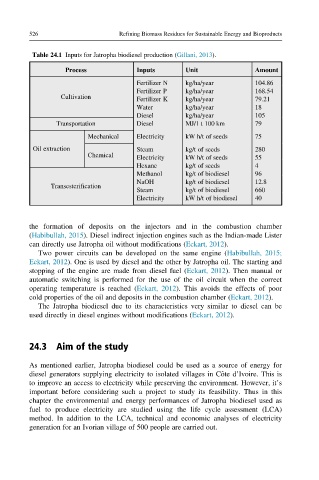
          Table 24.1 Inputs for Jatropha biodiesel production (Gillani, 2013).
                   Process            Inputs       Unit               Amount

                                      Fertilizer N  kg/ha/year        104.86
                                      Fertilizer P  kg/ha/year        168.54
                 Cultivation          Fertilizer K  kg/ha/year        79.21
                                      Water        kg/ha/year         18
                                      Diesel       kg/ha/year         105
                Transportation        Diesel       MJ/1 t 100 km      79

                         Mechanical   Electricity  kW h/t of seeds    75
          Oil extraction              Steam        kg/t of seeds      280
                         Chemical     Electricity  kW h/t of seeds    55
                                      Hexane       kg/t of seeds      4
                                      Methanol     kg/t of biodiesel  96
                                      NaOH         kg/t of biodiesel  12.8
               Transesterification
                                      Steam        kg/t of biodiesel  660
                                      Electricity  kW h/t of biodiesel  40


         the formation of deposits on the injectors and in the combustion chamber
         (Habibullah, 2015). Diesel indirect injection engines such as the Indian-made Lister
         can directly use Jatropha oil without modifications (Eckart, 2012).
           Two power circuits can be developed on the same engine (Habibullah, 2015;
         Eckart, 2012). One is used by diesel and the other by Jatropha oil. The starting and
         stopping of the engine are made from diesel fuel (Eckart, 2012). Then manual or
         automatic switching is performed for the use of the oil circuit when the correct
         operating temperature is reached (Eckart, 2012). This avoids the effects of poor
         cold properties of the oil and deposits in the combustion chamber (Eckart, 2012).
           The Jatropha biodiesel due to its characteristics very similar to diesel can be
         used directly in diesel engines without modifications (Eckart, 2012).


         24.3   Aim of the study

         As mentioned earlier, Jatropha biodiesel could be used as a source of energy for
         diesel generators supplying electricity to isolated villages in Cˆ ote d’Ivoire. This is
         to improve an access to electricity while preserving the environment. However, it’s
         important before considering such a project to study its feasibility. Thus in this
         chapter the environmental and energy performances of Jatropha biodiesel used as
         fuel to produce electricity are studied using the life cycle assessment (LCA)
         method. In addition to the LCA, technical and economic analyses of electricity
         generation for an Ivorian village of 500 people are carried out.

