


Page 578 - Refining Biomass Residues for Sustainable Energy and Bioproducts
P. 578
528                     Refining Biomass Residues for Sustainable Energy and Bioproducts


           Because of the complexity of the method and the multitude of data to be han-
         dled, software dedicated to the LCA exists. There are SimaPro, Gabi, OpenLCA,
         etc. (Benoist, 2009).

         24.4.1.2 Assumptions

         24.4.1.2.1 Objectives and scope study definition
         The objective of this LCA is to evaluate the environmental impact associated with
         the production and the use of Jatropha oil and biodiesel. The functional unit
         adopted in both cases is the production and the use of 1 t of biodiesel for electricity
         generation. This study should interest the authorities of the electricity sector in Cˆ ote
         d’Ivoire, with a view to developing renewable energies.
           Two scenarios are observed, namely, an industrial sector for scenario 1 where
         biodiesel is used as a source of energy and an artisanal sector for scenario 2 where
         Jatropha oil is used directly as a source of energy.
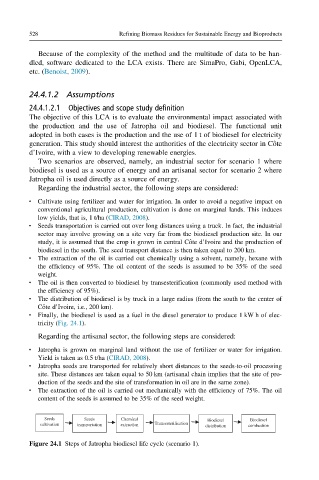
           Regarding the industrial sector, the following steps are considered:

            Cultivate using fertilizer and water for irrigation. In order to avoid a negative impact on
           conventional agricultural production, cultivation is done on marginal lands. This induces
           low yields, that is, 1 t/ha (CIRAD, 2008).
            Seeds transportation is carried out over long distances using a truck. In fact, the industrial
           sector may involve growing on a site very far from the biodiesel production site. In our
           study, it is assumed that the crop is grown in central Cˆ ote d’Ivoire and the production of
           biodiesel in the south. The seed transport distance is then taken equal to 200 km.
            The extraction of the oil is carried out chemically using a solvent, namely, hexane with
           the efficiency of 95%. The oil content of the seeds is assumed to be 35% of the seed
           weight.
            The oil is then converted to biodiesel by transesterification (commonly used method with
           the efficiency of 95%).
            The distribution of biodiesel is by truck in a large radius (from the south to the center of
           Cˆ ote d’Ivoire, i.e., 200 km).
            Finally, the biodiesel is used as a fuel in the diesel generator to produce 1 kW h of elec-
           tricity (Fig. 24.1).
           Regarding the artisanal sector, the following steps are considered:

            Jatropha is grown on marginal land without the use of fertilizer or water for irrigation.
           Yield is taken as 0.5 t/ha (CIRAD, 2008).
            Jatropha seeds are transported for relatively short distances to the seeds-to-oil processing
           site. These distances are taken equal to 50 km (artisanal chain implies that the site of pro-
           duction of the seeds and the site of transformation in oil are in the same zone).
            The extraction of the oil is carried out mechanically with the efficiency of 75%. The oil
           content of the seeds is assumed to be 35% of the seed weight.

             Seeds      Seeds     Chemical               Biodiesel   Biodiesel
            cultivation  transportation  extraction   Transesterification  distribution  combustion

         Figure 24.1 Steps of Jatropha biodiesel life cycle (scenario 1).

