


Page 309 - Reservoir Geomechanics
P. 309
286    Reservoir geomechanics


                                     Equivalent mud weight (ppg)
                        8      10     12     14     16     18     20
                       0


                    2000


                          P p          b
                                          c
                                            d             S
                                    a                      v
                    4000
                  Depth (TVDss)


                    6000                             e


                    8000


                    10000


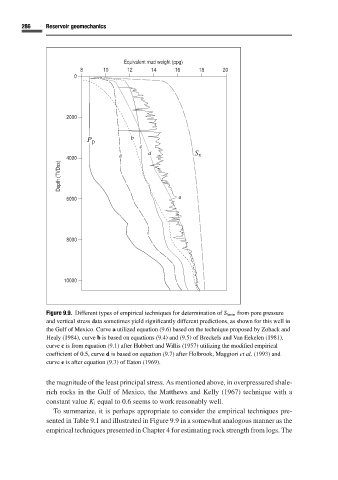
               Figure 9.9. Different types of empirical techniques for determination of S hmin from pore pressure
               and vertical stress data sometimes yield significantly different predictions, as shown for this well in
               the Gulf of Mexico. Curve a utilized equation (9.6) based on the technique proposed by Zoback and
               Healy (1984), curve b is based on equations (9.4) and (9.5)of Breckels and Van Eekelen (1981),
               curve c is from equation (9.1) after Hubbert and Willis (1957) utilizing the modified empirical
               coefficient of 0.5, curve d is based on equation (9.7) after Holbrook, Maggiori et al.(1993) and
               curve e is after equation (9.3)of Eaton (1969).

               the magnitude of the least principal stress. As mentioned above, in overpressured shale-
               rich rocks in the Gulf of Mexico, the Matthews and Kelly (1967) technique with a
               constant value K i equal to 0.6 seems to work reasonably well.
                 To summarize, it is perhaps appropriate to consider the empirical techniques pre-
               sented in Table 9.1 and illustrated in Figure 9.9 in a somewhat analogous manner as the
               empirical techniques presented in Chapter 4 for estimating rock strength from logs. The

