


Page 306 - Reservoir Geomechanics
P. 306
283    Stress fields


        a.                                    b.
          9100
                                               10000
                                                       9,400 psi
          9200
                                                9000


          9300                                  8000            SHALE
         Depth (feet)                          Measured stress (psi)


          9400                                  7000                         8,000 psi


                                                                 SAND
          9500
                                                6000


          9600
                                                5000

                50 100  150  6000  7000  8000
                                                      5000   6000   7000   8000   9000
                Gamma         Stress (psi)
                                                             Log calculated stress (psi)
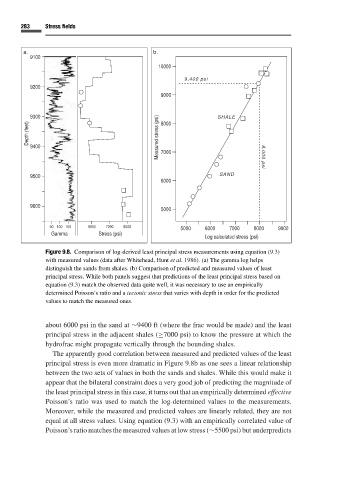
              Figure 9.8. Comparison of log-derived least principal stress measurements using equation (9.3)
              with measured values (data after Whitehead, Hunt et al. 1986). (a) The gamma log helps
              distinguish the sands from shales. (b) Comparison of predicted and measured values of least
              principal stress. While both panels suggest that predictions of the least principal stress based on
              equation (9.3) match the observed data quite well, it was necessary to use an empirically
              determined Poisson’s ratio and a tectonic stress that varies with depth in order for the predicted
              values to match the measured ones.


              about 6000 psi in the sand at ∼9400 ft (where the frac would be made) and the least
              principal stress in the adjacent shales (≥7000 psi) to know the pressure at which the
              hydrofrac might propagate vertically through the bounding shales.
                The apparently good correlation between measured and predicted values of the least
              principal stress is even more dramatic in Figure 9.8bas one sees a linear relationship
              between the two sets of values in both the sands and shales. While this would make it
              appear that the bilateral constraint does a very good job of predicting the magnitude of
              the least principal stress in this case, it turns out that an empirically determined effective
              Poisson’s ratio was used to match the log-determined values to the measurements.
              Moreover, while the measured and predicted values are linearly related, they are not
              equal at all stress values. Using equation (9.3) with an empirically correlated value of
              Poisson’s ratio matches the measured values at low stress (∼5500 psi) but underpredicts

