


Page 305 - Reservoir Geomechanics
P. 305
282    Reservoir geomechanics


               from 0.4 and 0.48 at 2000 ft to values exceeding 0.7 at depths greater than 10,000 ft
               (see also Mouchet and Mitchell 1989).
                 Eaton (1969) suggested a physically based technique for determination of the least
               principal stress based on Poisson’s ratio, ν.


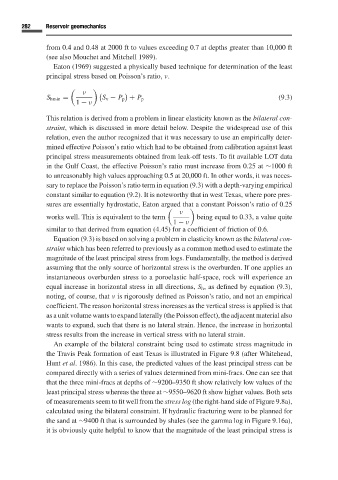
                         ν
               S hmin =        S v − P p + P p                                    (9.3)
                       1 − ν
               This relation is derived from a problem in linear elasticity known as the bilateral con-
               straint, which is discussed in more detail below. Despite the widespread use of this
               relation, even the author recognized that it was necessary to use an empirically deter-
               mined effective Poisson’s ratio which had to be obtained from calibration against least
               principal stress measurements obtained from leak-off tests. To fit available LOT data
               in the Gulf Coast, the effective Poisson’s ratio must increase from 0.25 at ∼1000 ft
               to unreasonably high values approaching 0.5 at 20,000 ft. In other words, it was neces-
               sary to replace the Poisson’s ratio term in equation (9.3) with a depth-varying empirical
               constant similar to equation (9.2). It is noteworthy that in west Texas, where pore pres-
               sures are essentially hydrostatic, Eaton argued that a constant Poisson’s ratio of 0.25
                                                     ν

               works well. This is equivalent to the term  being equal to 0.33, a value quite
                                                    1 − ν
               similar to that derived from equation (4.45) for a coefficient of friction of 0.6.
                 Equation (9.3)is based on solving a problem in elasticity known as the bilateral con-
               straint which has been referred to previously as a common method used to estimate the
               magnitude of the least principal stress from logs. Fundamentally, the method is derived
               assuming that the only source of horizontal stress is the overburden. If one applies an
               instantaneous overburden stress to a poroelastic half-space, rock will experience an
               equal increase in horizontal stress in all directions, S h ,as defined by equation (9.3),
               noting, of course, that ν is rigorously defined as Poisson’s ratio, and not an empirical
               coefficient. The reason horizontal stress increases as the vertical stress is applied is that
               as a unit volume wants to expand laterally (the Poisson effect), the adjacent material also
               wants to expand, such that there is no lateral strain. Hence, the increase in horizontal
               stress results from the increase in vertical stress with no lateral strain.
                 An example of the bilateral constraint being used to estimate stress magnitude in
               the Travis Peak formation of east Texas is illustrated in Figure 9.8 (after Whitehead,
               Hunt et al. 1986). In this case, the predicted values of the least principal stress can be
               compared directly with a series of values determined from mini-fracs. One can see that
               that the three mini-fracs at depths of ∼9200–9350 ft show relatively low values of the
               least principal stress whereas the three at ∼9550–9620 ft show higher values. Both sets
               of measurements seem to fit well from the stress log (the right-hand side of Figure 9.8a),
               calculated using the bilateral constraint. If hydraulic fracturing were to be planned for
               the sand at ∼9400 ft that is surrounded by shales (see the gamma log in Figure 9.16a),
               it is obviously quite helpful to know that the magnitude of the least principal stress is

