


Page 426 - Robot Builder's Bonanza
P. 426
DIODES  395


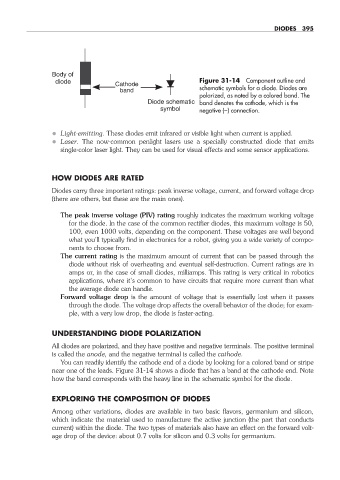
                   Body of
                    diode           Cathode                 Figure 31- 14  Component outline and
                                      band                  schematic symbols for a diode. Diodes are
                                                            polarized, as noted by a colored band. The
                                              Diode schematic  band denotes the cathode, which is the
                                                 symbol     negative (–) connection.


                   •    Light- emitting. These diodes emit infrared or visible light when current is applied.
                   •  Laser. The  now- common penlight lasers use a specially constructed diode that emits
                       single- color laser light. They can be used for visual effects and some sensor applications.


                   HOW DIODES ARE RATED
                   Diodes carry three important ratings: peak inverse voltage, current, and forward voltage drop
                   (there are others, but these are the main ones).

                     The peak inverse voltage (PIV) rating roughly indicates the maximum working voltage
                       for the diode. In the case of the common rectifier diodes, this maximum voltage is 50,
                       100, even 1000 volts, depending on the component. These voltages are well beyond
                       what you’ll typically find in electronics for a robot, giving you a wide variety of compo-
                       nents to choose from.
                     The current rating is the maximum amount of current that can be passed through the
                       diode without risk of overheating and eventual  self- destruction. Current ratings are in
                       amps or, in the case of small diodes, milliamps. This rating is very critical in robotics
                       applications, where it’s common to have circuits that require more current than what
                       the average diode can handle.
                     Forward voltage drop is the amount of voltage that is essentially lost when it passes
                       through the diode. The voltage drop affects the overall behavior of the diode; for exam-
                       ple, with a very low drop, the diode is  faster- acting.


                   UNDERSTANDING DIODE POLARIZATION
                   All diodes are polarized, and they have positive and negative terminals. The positive terminal
                   is called the anode, and the negative terminal is called the cathode.
                     You can readily identify the cathode end of a diode by looking for a colored band or stripe
                   near one of the leads. Figure 31- 14 shows a diode that has a band at the cathode end. Note
                   how the band corresponds with the heavy line in the schematic symbol for the diode.

                   EXPLORING THE COMPOSITION OF DIODES
                   Among other variations, diodes are available in two basic flavors, germanium and silicon,
                   which indicate the material used to manufacture the active junction (the part that conducts
                   current) within the diode. The two types of materials also have an effect on the forward volt-
                   age drop of the device: about 0.7 volts for silicon and 0.3 volts for germanium.


 31-chapter-31.indd   395                                                                   4/21/11   11:56 AM

