


Page 425 - Robot Builder's Bonanza
P. 425
394    COMMON ELECTRONIC COMPONENTS FOR ROBOTICS


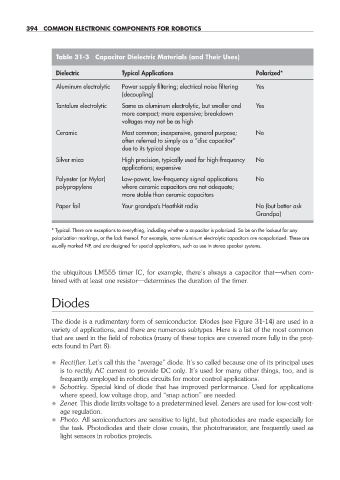
                    Table 31- 3  Capacitor Dielectric Materials (and Their Uses)

                    Dielectric        Typical Applications                  Polarized*
                    Aluminum electrolytic   Power supply filtering; electrical noise filtering   Yes
                                      (decoupling)
                    Tantalum electrolytic   Same as aluminum electrolytic, but smaller and   Yes
                                      more compact; more expensive; breakdown
                                      voltages may not be as high
                    Ceramic           Most common; inexpensive, general purpose;    No
                                      often referred to simply as a “disc capacitor”
                                      due to its typical shape
                    Silver mica       High precision, typically used for  high- frequency  No
                                      applications; expensive
                    Polyester (or Mylar)   Low- power,  low- frequency signal  applications  No
                    polypropylene     where ceramic capacitors are not adequate;
                                      more stable than ceramic capacitors
                    Paper foil        Your grandpa’s Heathkit radio         No (but better ask
                                                                            Grandpa)


                   * Typical. There are exceptions to everything, including whether a capacitor is polarized. So be on the lookout for any
                   polarization markings, or the lack thereof. For example, some aluminum electrolytic capacitors are nonpolarized. These are
                   usually marked NP, and are designed for special applications, such as use in stereo speaker systems.


                   the ubiquitous LM555 timer IC, for example, there’s always a capacitor  that— when com-
                   bined with at least one  resistor— determines the duration of the timer.


                   Diodes


                   The diode is a rudimentary form of semiconductor. Diodes (see Figure 31- 14) are used in a
                   variety of applications, and there are numerous subtypes. Here is a list of the most common
                   that are used in the field of robotics (many of these topics are covered more fully in the proj-
                   ects found in Part 8):
                   •   Rectifier. Let’s call this the “average” diode. It’s so called because one of its principal uses
                     is to rectify AC current to provide DC only. It’s used for many other things, too, and is
                     frequently employed in robotics circuits for motor control applications.
                   •   Schottky. Special kind of diode that has improved performance. Used for applications
                     where speed, low voltage drop, and “snap action” are needed.
                   •   Zener. This diode limits voltage to a predetermined level. Zeners are used for  low- cost volt-
                     age regulation.
                   •   Photo. All semiconductors are sensitive to light, but photodiodes are made especially for
                     the task. Photodiodes and their close cousin, the phototransistor, are frequently used as
                     light sensors in robotics projects.


   31-chapter-31.indd   394                                                                     4/21/11   11:56 AM

