


Page 271 - Robot Builders Source Book - Gordon McComb
P. 271
7.7 Passive Orientation                       259


        7.7     Passive Orientation

           Passive orientation is based on the idea of keeping on the tray only those parts or
        details that are oriented as desired. The wrongly oriented parts are simply thrown off
        the tray for additional trials. The working principles of this orientation are explained
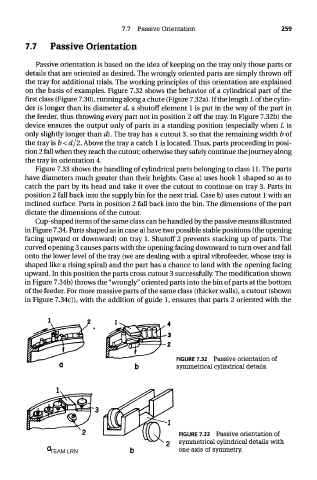
        on the basis of examples. Figure 7.32 shows the behavior of a cylindrical part of the
        first class (Figure 7.30), running along a chute (Figure 7.32a). If the length L of the cylin-
        der is longer than its diameter d, a shutoff element 1 is put in the way of the part in
        the feeder, thus throwing every part not in position 2 off the tray. In Figure 7.32b) the
        device ensures the output only of parts in a standing position (especially when L is
        only slightly longer than d). The tray has a cutout 3, so that the remaining width b of
        the tray is b < d/2. Above the tray a catch 1 is located. Thus, parts proceeding in posi-
        tion 2 fall when they reach the cutout; otherwise they safely continue the journey along
        the tray in orientation 4.
           Figure 7.33 shows the handling of cylindrical parts belonging to class 11. The parts
        have diameters much greater than their heights. Case a) uses hook 1 shaped so as to
        catch the part by its head and take it over the cutout to continue on tray 3. Parts in
        position 2 fall back into the supply bin for the next trial. Case b) uses cutout 1 with an
        inclined surface. Parts in position 2 fall back into the bin. The dimensions of the part
        dictate the dimensions of the cutout.
           Cup-shaped items of the same class can be handled by the passive means illustrated
        in Figure 7.34. Parts shaped as in case a) have two possible stable positions (the opening
        facing upward or downward) on tray 1. Shutoff 2 prevents stacking up of parts. The
        curved opening 3 causes parts with the opening facing downward to turn over and fall
        onto the lower level of the tray (we are dealing with a spiral vibrofeeder, whose tray is
        shaped like a rising spiral) and the part has a chance to land with the opening facing
        upward. In this position the parts cross cutout 3 successfully. The modification shown
        in Figure 7.34b) throws the "wrongly" oriented parts into the bin of parts at the bottom
        of the feeder. For more massive parts of the same class (thicker walls), a cutout (shown
        in Figure 7.34c)), with the addition of guide 1, ensures that parts 2 oriented with the


                                                    FIGURE 7.32 Passive orientation of
                                                    symmetrical cylindrical details.


                                                     FIGURE 7.33 Passive orientation of
                                                     symmetrical cylindrical details with
               TEAM LRN                              one axis of symmetry.

