


Page 273 - Robot Builders Source Book - Gordon McComb
P. 273
7.7 Passive Orientation                       261


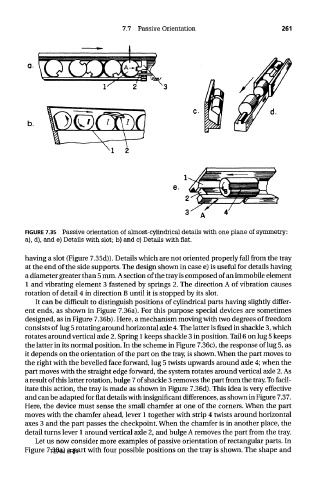
        FIGURE 7.35 Passive orientation of almost-cylindrical details with one plane of symmetry:
        a), d), and e) Details with slot; b) and c) Details with flat.


        having a slot (Figure 7.35d)). Details which are not oriented properly fall from the tray
        at the end of the side supports. The design shown in case e) is useful for details having
        a diameter greater than 5 mm. A section of the tray is composed of an immobile element
        1 and vibrating element 3 fastened by springs 2. The direction A of vibration causes
        rotation of detail 4 in direction B until it is stopped by its slot.
           It can be difficult to distinguish positions of cylindrical parts having slightly differ-
        ent ends, as shown in Figure 7.36a). For this purpose special devices are sometimes
        designed, as in Figure 7.36b). Here, a mechanism moving with two degrees of freedom
        consists of lug 5 rotating around horizontal axle 4. The latter is fixed in shackle 3, which
        rotates around vertical axle 2. Spring 1 keeps shackle 3 in position. Tail 6 on lug 5 keeps
        the latter in its normal position. In the scheme in Figure 7.36c), the response of lug 5, as
        it depends on the orientation of the part on the tray, is shown. When the part moves to
        the right with the bevelled face forward, lug 5 twists upwards around axle 4; when the
        part moves with the straight edge forward, the system rotates around vertical axle 2. As
        a result of this latter rotation, bulge 7 of shackle 3 removes the part from the tray. To facil-
        itate this action, the tray is made as shown in Figure 7.36d). This idea is very effective
        and can be adapted for flat details with insignificant differences, as shown in Figure 7.37.
        Here, the device must sense the small chamfer at one of the corners. When the part
        moves with the chamfer ahead, lever 1 together with strip 4 twists around horizontal
        axes 3 and the part passes the checkpoint. When the chamfer is in another place, the
        detail turns lever 1 around vertical axle 2, and bulge A removes the part from the tray.
           Let us now consider more examples of passive orientation of rectangular parts. In
               TEAM LRN
        Figure 7.38a) a part with four possible positions on the tray is shown. The shape and

