


Page 59 - Robot Builders Source Book - Gordon McComb
P. 59
48                           Concepts and Layouts


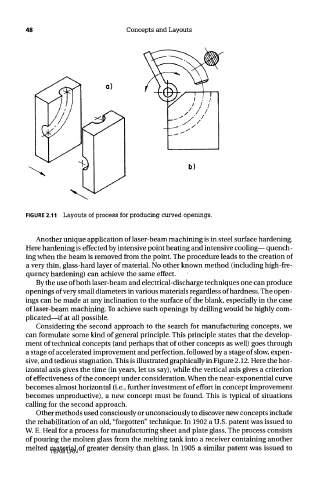
        FIGURE 2.11 Layouts of process for producing curved openings.


           Another unique application of laser-beam machining is in steel surface hardening.
        Here hardening is effected by intensive point heating and intensive cooling— quench-
        ing when the beam is removed from the point. The procedure leads to the creation of
        a very thin, glass-hard layer of material. No other known method (including high-fre-
        quency hardening) can achieve the same effect.
           By the use of both laser-beam and electrical-discharge techniques one can produce
        openings of very small diameters in various materials regardless of hardness. The open-
        ings can be made at any inclination to the surface of the blank, especially in the case
        of laser-beam machining. To achieve such openings by drilling would be highly com-
        plicated—if at all possible.
           Considering the second approach to the search for manufacturing concepts, we
        can formulate some kind of general principle. This principle states that the develop-
        ment of technical concepts (and perhaps that of other concepts as well) goes through
        a stage of accelerated improvement and perfection, followed by a stage of slow, expen-
        sive, and tedious stagnation. This is illustrated graphically in Figure 2.12. Here the hor-
        izontal axis gives the time (in years, let us say), while the vertical axis gives a criterion
        of effectiveness of the concept under consideration. When the near-exponential curve
        becomes almost horizontal (i.e., further investment of effort in concept improvement
        becomes unproductive), a new concept must be found. This is typical of situations
        calling for the second approach.
           Other methods used consciously or unconsciously to discover new concepts include
        the rehabilitation of an old, "forgotten" technique. In 1902 a U.S. patent was issued to
        W. E. Heal for a process for manufacturing sheet and plate glass. The process consists
        of pouring the molten glass from the melting tank into a receiver containing another
        melted material of greater density than glass. In 1905 a similar patent was issued to
               TEAM LRN

