


Page 232 - Robotics Designing the Mechanisms for Automated Machinery
P. 232
220                          Transporting Devices

        holding the cross during its rest, the curved parts of the cross are locked by disc 9. Shaft
        8 also drives cam 10 which is used for raising and lowering the indexing table with the
        aid of fork-like follower 11, which is connected to roller 12. Fork 11 is engaged with
        bushing 13. The indexing table is balanced by spring 14. This structure allows the double
        motion of the indexing mechanism to be carried out. This mechanism can be used,
        for example, to take parts (by means of suction cups or other grippers) from their posi-
        tions, transfer them to the next positions, and lower them into their places. The move-
        ment of the suction cups is graphed in Figure 6.17a).
           The indexing mechanism can also be designed so as to carry out recurrent angular
        motion in combination with reciprocating vertical motion. A diagram of this motion
        is shown in Figure 6.17b). The advantage of this kind of motion is that flexible means
        of communication can be used, e.g., electric wires, hoses, pipes, whereas in the pre-
        vious case special methods are required to connect suction cups to a central vacuum
        pump to avoid leakage of air into the system and prevent the hoses from twisting.
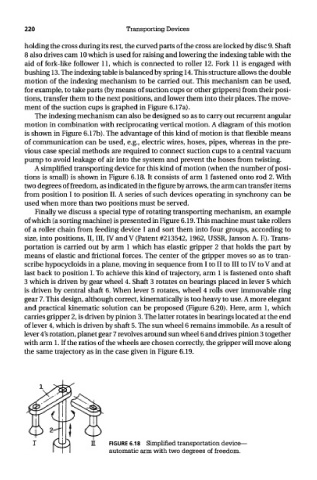
           A simplified transporting device for this kind of motion (when the number of posi-
        tions is small) is shown in Figure 6.18. It consists of arm 1 fastened onto rod 2. With
        two degrees of freedom, as indicated in the figure by arrows, the arm can transfer items
        from position I to position II. A series of such devices operating in synchrony can be
        used when more than two positions must be served.
           Finally we discuss a special type of rotating transporting mechanism, an example
        of which (a sorting machine) is presented in Figure 6.19. This machine must take rollers
        of a roller chain from feeding device I and sort them into four groups, according to
        size, into positions, II, III, IV and V (Patent #213542, 1962, USSR, Janson A. F). Trans-
        portation is carried out by arm 1 which has elastic gripper 2 that holds the part by
        means of elastic and frictional forces. The center of the gripper moves so as to tran-
        scribe hypocycloids in a plane, moving in sequence from I to II to III to IV to V and at
        last back to position I. To achieve this kind of trajectory, arm 1 is fastened onto shaft
        3 which is driven by gear wheel 4. Shaft 3 rotates on bearings placed in lever 5 which
        is driven by central shaft 6. When lever 5 rotates, wheel 4 rolls over immovable ring
        gear 7. This design, although correct, kinematically is too heavy to use. A more elegant
        and practical kinematic solution can be proposed (Figure 6.20). Here, arm 1, which
        carries gripper 2, is driven by pinion 3. The latter rotates in bearings located at the end
        of lever 4, which is driven by shaft 5. The sun wheel 6 remains immobile. As a result of
        lever 4's rotation, planet gear 7 revolves around sun wheel 6 and drives pinion 3 together
        with arm 1. If the ratios of the wheels are chosen correctly, the gripper will move along
        the same trajectory as in the case given in Figure 6.19.


                                FIGURE 6.18 Simplified transportation device—
                                automatic arm with two degrees of freedom.

