


Page 57 - Robotics Designing the Mechanisms for Automated Machinery
P. 57
46                           Concepts and Layouts


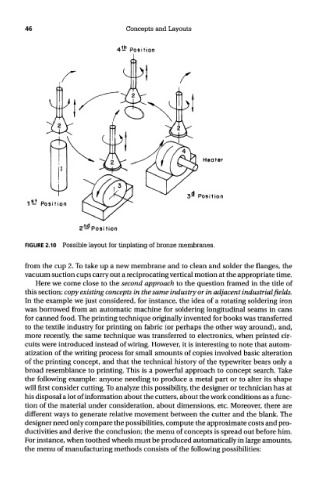
         FIGURE 2.10 Possible layout for tinplating of bronze membranes.


         from the cup 2. To take up a new membrane and to clean and solder the flanges, the
         vacuum suction cups carry out a reciprocating vertical motion at the appropriate time.
            Here we come close to the second approach to the question framed in the title of
         this section: copy existing concepts in the same industry or in adjacent industrial fields.
         In the example we just considered, for instance, the idea of a rotating soldering iron
         was borrowed from an automatic machine for soldering longitudinal seams in cans
         for canned food. The printing technique originally invented for books was transferred
         to the textile industry for printing on fabric (or perhaps the other way around), and,
         more recently, the same technique was transferred to electronics, when printed cir-
         cuits were introduced instead of wiring. However, it is interesting to note that autom-
         atization of the writing process for small amounts of copies involved basic alteration
         of the printing concept, and that the technical history of the typewriter bears only a
         broad resemblance to printing. This is a powerful approach to concept search. Take
         the following example: anyone needing to produce a metal part or to alter its shape
         will first consider cutting. To analyze this possibility, the designer or technician has at
         his disposal a lot of information about the cutters, about the work conditions as a func-
         tion of the material under consideration, about dimensions, etc. Moreover, there are
         different ways to generate relative movement between the cutter and the blank. The
         designer need only compare the possibilities, compute the approximate costs and pro-
         ductivities and derive the conclusion; the menu of concepts is spread out before him.
         For instance, when toothed wheels must be produced automatically in large amounts,
         the menu of manufacturing methods consists of the following possibilities:

