


Page 92 - Robotics Designing the Mechanisms for Automated Machinery
P. 92
3.3 Electric Drives                          81

        ior of motors provided with permanent magnet rotors, while curve 3 represents that
        of variable reluctance motors.
           Now that we have learned the characteristics of the most frequently used electro-
        motors as drives for automatic machines and systems, some other comparative fea-
        tures of these electromotors must be discussed.
           The advantage of DC motors lies in the ease of speed control, whereas speed control
        in AC motors requires the installation of sophisticated equipment (frequency trans-
        formers). The advantage of AC motors (both one- and three-phase) is that they operate
        on the standard voltage available at any industrial site. In addition, a three-phase induc-
        tion motor with a squirrel-cage rotor is cheaper than any other type of motor of the
        same power. For accurate positioning both DC and AC motors require feedbacks. In
        contrast, stepper motors, although more expensive, are suitable for accurate posi-
        tioning (almost always without any feedback) and speed control. Such motors are con-
        venient for engagement with digital means (computers).
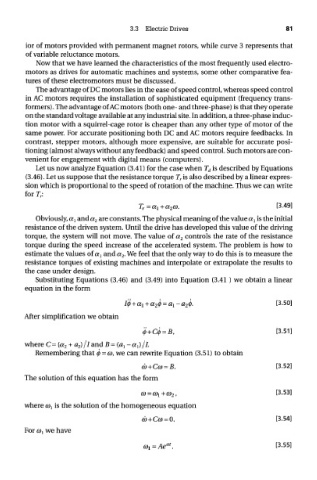
           Let us now analyze Equation (3.41) for the case when T d is described by Equations
        (3.46). Let us suppose that the resistance torque T r is also described by a linear expres-
        sion which is proportional to the speed of rotation of the machine. Thus we can write
        for T r:


           Obviously, a l andor 2 are constants. The physical meaning of the value a 1 is the initial
        resistance of the driven system. Until the drive has developed this value of the driving
        torque, the system will not move. The value of a 2 controls the rate of the resistance
        torque during the speed increase of the accelerated system. The problem is how to
        estimate the values of a^ and a 2. We feel that the only way to do this is to measure the
        resistance torques of existing machines and interpolate or extrapolate the results to
        the case under design.
           Substituting Equations (3.46) and (3.49) into Equation (3.41 ) we obtain a linear
        equation in the form


        After simplification we obtain


        where C = (oc 2 + « 2) /I  an d B=(a l- a^) /I.
           Remembering that 0 = CD, we can rewrite Equation (3.51) to obtain


        The solution of this equation has the form


        where ^ is the solution of the homogeneous equation


        For co l we have

