


Page 158 - Science at the nanoscale
P. 158
10:15
                                                     RPS: PSP0007 - Science-at-Nanoscale
                   June 5, 2009
                              Formation and Self-Assembly at the Nanoscale
                         148
                                            super
                                           saturated
                                                     insoluble
                                            solutes
                                                     nuclei
                                                                    nanoparticles
                                                           nucleation
                                                                      growth
                                           concentration
                                                                     nucleation concentration
                                                                     saturation concentration
                                           solute
                                                                                   time
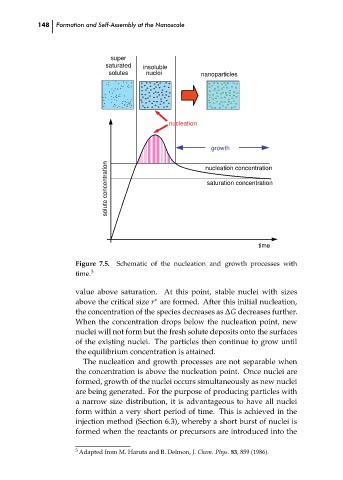
                                              Schematic of the nucleation and growth processes with
                                   Figure 7.5.
                                       3
                                   time.
                                   value above saturation. At this point, stable nuclei with sizes
                                                        ∗
                                   above the critical size r are formed. After this initial nucleation,
                                   the concentration of the species decreases as ∆G decreases further.
                                   When the concentration drops below the nucleation point, new
                                   nuclei will not form but the fresh solute deposits onto the surfaces
                                   of the existing nuclei. The particles then continue to grow until  ch07
                                   the equilibrium concentration is attained.
                                     The nucleation and growth processes are not separable when
                                   the concentration is above the nucleation point. Once nuclei are
                                   formed, growth of the nuclei occurs simultaneously as new nuclei
                                   are being generated. For the purpose of producing particles with
                                   a narrow size distribution, it is advantageous to have all nuclei
                                   form within a very short period of time. This is achieved in the
                                   injection method (Section 6.3), whereby a short burst of nuclei is
                                   formed when the reactants or precursors are introduced into the
                                   3  Adapted from M. Haruta and B. Delmon, J. Chem. Phys. 83, 859 (1986).

