


Page 155 - Science at the nanoscale
P. 155
RPS: PSP0007 - Science-at-Nanoscale
                             10:15
                   June 5, 2009
                                                            7.1. Some Basic Thermodynamic Definitions
                                            6
                                              G
                                   G
                                                                                  G
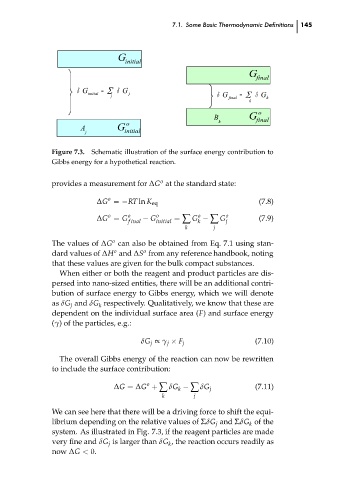
                                       Schematic illustration of the surface energy contribution to
                             Figure 7.3.
                             Gibbs energy for a hypothetical reaction.
                                                         o
                             provides a measurement for ∆G at the standard state:
                                           o
                                                                                   (7.8)
                                         ∆G = −RT ln K eq
                                           o
                                                 o
                                                                   o
                                                        o
                                         ∆G = G
                                                    − G
                                                                                   (7.9)
                                                                   k ∑
                                                             =
                                                        initial
                                                 f inal
                                                                k
                                             o
                             The values of ∆G can also be obtained from Eq. 7.1 using stan-
                                                     o
                                             o
                             dard values of ∆H and ∆S from any reference handbook, noting
                             that these values are given for the bulk compact substances.
                               When either or both the reagent and product particles are dis-
                             persed into nano-sized entities, there will be an additional contri-
                             bution of surface energy to Gibbs energy, which we will denote
                             as δG and δG respectively. Qualitatively, we know that these are
                                         k
                                  j
                             dependent on the individual surface area (F) and surface energy
                             (γ) of the particles, e.g.:
                                                    δG j ∝ γ j × F j ∑  G −  j G G o j    6 (7.10)  145  ch07
                               The overall Gibbs energy of the reaction can now be rewritten
                             to include the surface contribution:
                                                      o
                                                              k ∑
                                             ∆G = ∆G +   ∑  δG −   δG j           (7.11)
                                                          k       j
                             We can see here that there will be a driving force to shift the equi-
                             librium depending on the relative values of ΣδG j and ΣδG of the
                                                                                k
                             system. As illustrated in Fig. 7.3, if the reagent particles are made
                             very fine and δG is larger than δG , the reaction occurs readily as
                                            j
                                                           k
                             now ∆G < 0.

