


Page 157 - Science at the nanoscale
P. 157
RPS: PSP0007 - Science-at-Nanoscale
                             10:15
                   June 5, 2009
                                                                      7.2. The Bottom-Up Approach
                                 G
                                ∆
                                                                      ∆µs
                              ∆
                               G*
                                                                                Radius
                                                             r*
                                                     ∆µ v
                                                                          Total ∆G
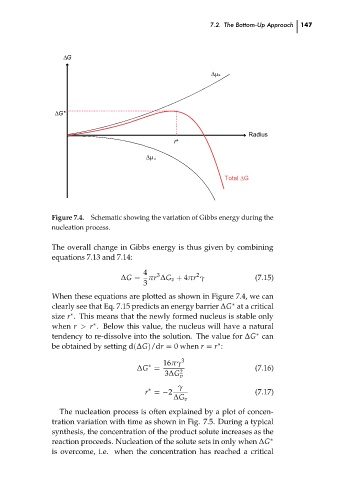
                             Figure 7.4.
                                       Schematic showing the variation of Gibbs energy during the
                             nucleation process.
                             The overall change in Gibbs energy is thus given by combining
                             equations 7.13 and 7.14:
                                                     4
                                                                  2
                                                        3
                                                                                  (7.15)
                                                      πr ∆G v + 4πr γ
                                               ∆G =
                                                     3
                             When these equations are plotted as shown in Figure 7.4, we can
                             clearly see that Eq. 7.15 predicts an energy barrier ∆G at a critical
                                                                            ∗
                             size r . This means that the newly formed nucleus is stable only
                                  ∗
                             when r > r . Below this value, the nucleus will have a natural
                                        ∗
                             tendency to re-dissolve into the solution. The value for ∆G can  147  ch07
                                                                                  ∗
                             be obtained by setting d(∆G)/dr = 0 when r = r :
                                                                        ∗
                                                               3
                                                          16πγ
                                                      ∗
                                                   ∆G =       2                   (7.16)
                                                          3∆G v
                                                              γ
                                                      ∗
                                                     r = −2                       (7.17)
                                                            ∆G v
                               The nucleation process is often explained by a plot of concen-
                             tration variation with time as shown in Fig. 7.5. During a typical
                             synthesis, the concentration of the product solute increases as the
                             reaction proceeds. Nucleation of the solute sets in only when ∆G ∗
                             is overcome, i.e. when the concentration has reached a critical

