


Page 154 - Science at the nanoscale
P. 154
10:15
                                                     RPS: PSP0007 - Science-at-Nanoscale
                   June 5, 2009
                         144
                              Formation and Self-Assembly at the Nanoscale
                                                                          At equilibrium:
                                          Solute A + Solvent B
                                                                                 A(Solvated)
                                                                      A(Solid)
                                          Solid A
                                                                                  (Solute)
                                                                        ˇ  µ
                                                         (Solute)
                                                       µ
                                           (Solid)
                                                                          (Solid)= µ ˇ   A
                                                                         A
                                         µ
                                                        A
                                          A
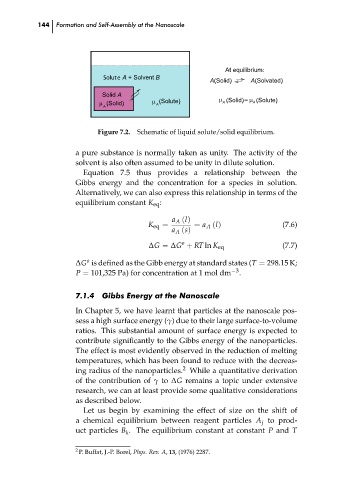
                                         Figure 7.2.
                                                   Schematic of liquid solute/solid equilibrium.
                                   a pure substance is normally taken as unity. The activity of the
                                   solvent is also often assumed to be unity in dilute solution.
                                     Equation 7.5 thus provides a relationship between the
                                   Gibbs energy and the concentration for a species in solution.
                                   Alternatively, we can also express this relationship in terms of the
                                   equilibrium constant K eq :
                                                            a A (l)
                                                                                         (7.6)
                                                                  = a A (l)
                                                      K eq =
                                                            a A (s)
                                                               o
                                                                                         (7.7)
                                                      ∆G = ∆G + RT ln K eq
                                      o
                                   ∆G is defined as the Gibb energy at standard states (T = 298.15 K;
                                                                           −3
                                   P = 101,325 Pa) for concentration at 1 mol dm
                                                                              .
                                          Gibbs Energy at the Nanoscale
                                   7.1.4
                                   In Chapter 5, we have learnt that particles at the nanoscale pos-
                                   sess a high surface energy (γ) due to their large surface-to-volume
                                   ratios. This substantial amount of surface energy is expected to
                                   contribute significantly to the Gibbs energy of the nanoparticles.  ch07
                                   The effect is most evidently observed in the reduction of melting
                                   temperatures, which has been found to reduce with the decreas-
                                                               2
                                   ing radius of the nanoparticles. While a quantitative derivation
                                   of the contribution of γ to ∆G remains a topic under extensive
                                   research, we can at least provide some qualitative considerations
                                   as described below.
                                     Let us begin by examining the effect of size on the shift of
                                   a chemical equilibrium between reagent particles A to prod-
                                                                                   j
                                   uct particles B . The equilibrium constant at constant P and T
                                                k
                                   2  P. Buffat, J.-P. Borel, Phys. Rev. A, 13, (1976) 2287.

