


Page 152 - Science at the nanoscale
P. 152
10:15
                                                     RPS: PSP0007 - Science-at-Nanoscale
                   June 5, 2009
                              Formation and Self-Assembly at the Nanoscale
                         142
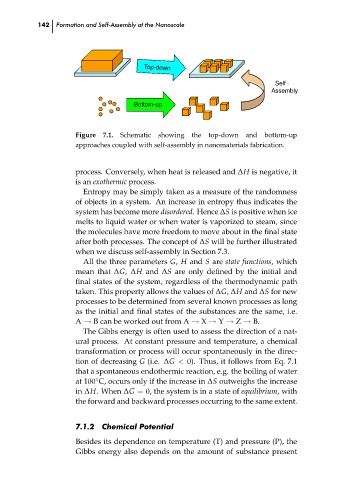
                                                     Top-down
                                                                                       Self -
                                                                                      Assembly
                                                  Bottom-up
                                                                      top-down
                                                         showing
                                                                                    bottom-up
                                               Schematic
                                          7.1.
                                   Figure
                                                                               and
                                                                 the
                                   approaches coupled with self-assembly in nanomaterials fabrication.
                                   process. Conversely, when heat is released and ∆H is negative, it
                                   is an exothermic process.
                                     Entropy may be simply taken as a measure of the randomness
                                   of objects in a system. An increase in entropy thus indicates the
                                   system has become more disordered. Hence ∆S is positive when ice
                                   melts to liquid water or when water is vaporized to steam, since
                                   the molecules have more freedom to move about in the final state
                                   after both processes. The concept of ∆S will be further illustrated
                                   when we discuss self-assembly in Section 7.3.
                                     All the three parameters G, H and S are state functions, which
                                   mean that ∆G, ∆H and ∆S are only defined by the initial and
                                   final states of the system, regardless of the thermodynamic path
                                   taken. This property allows the values of ∆G, ∆H and ∆S for new
                                   processes to be determined from several known processes as long
                                   as the initial and final states of the substances are the same, i.e.
                                   A → B can be worked out from A → X → Y → Z → B.
                                     The Gibbs energy is often used to assess the direction of a nat-
                                   ural process. At constant pressure and temperature, a chemical  ch07
                                   transformation or process will occur spontaneously in the direc-
                                   tion of decreasing G (i.e. ∆G < 0). Thus, it follows from Eq. 7.1
                                   that a spontaneous endothermic reaction, e.g. the boiling of water
                                   at 100 C, occurs only if the increase in ∆S outweighs the increase
                                        ◦
                                   in ∆H. When ∆G = 0, the system is in a state of equilibrium, with
                                   the forward and backward processes occurring to the same extent.
                                   7.1.2  Chemical Potential
                                   Besides its dependence on temperature (T) and pressure (P), the
                                   Gibbs energy also depends on the amount of substance present

