


Page 147 - Science at the nanoscale
P. 147
RPS: PSP0007 - Science-at-Nanoscale
                             8:11
                   June 9, 2009
                                                                 6.3. Quantum Dots, Quantum Wires
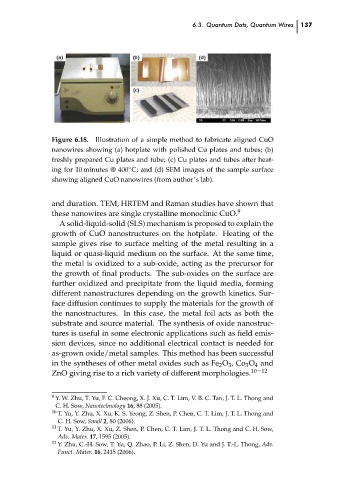
                             Figure 6.18.
                                        Illustration of a simple method to fabricate aligned CuO
                             nanowires showing (a) hotplate with polished Cu plates and tubes; (b)
                             freshly prepared Cu plates and tube; (c) Cu plates and tubes after heat-
                             ing for 10 minutes @ 400 C; and (d) SEM images of the sample surface
                                                 ◦
                             showing aligned CuO nanowires (from author’s lab).
                             and duration. TEM, HRTEM and Raman studies have shown that
                                                                             9
                             these nanowires are single crystalline monoclinic CuO.
                               A solid-liquid-solid (SLS) mechanism is proposed to explain the
                             growth of CuO nanostructures on the hotplate. Heating of the
                             sample gives rise to surface melting of the metal resulting in a
                             liquid or quasi-liquid medium on the surface. At the same time,
                             the metal is oxidized to a sub-oxide, acting as the precursor for
                             the growth of final products. The sub-oxides on the surface are
                             further oxidized and precipitate from the liquid media, forming
                             different nanostructures depending on the growth kinetics. Sur-
                             face diffusion continues to supply the materials for the growth of
                             the nanostructures. In this case, the metal foil acts as both the
                             substrate and source material. The synthesis of oxide nanostruc-
                             tures is useful in some electronic applications such as field emis-  137  ch06
                             sion devices, since no additional electrical contact is needed for
                             as-grown oxide/metal samples. This method has been successful
                             in the syntheses of other metal oxides such as Fe 2 O 3 , Co 3 O 4 and
                             ZnO giving rise to a rich variety of different morphologies. 10–12
                             9  Y. W. Zhu, T. Yu, F. C. Cheong, X. J. Xu, C. T. Lim, V. B. C. Tan, J. T. L. Thong and
                              C. H. Sow, Nanotechnology 16, 88 (2005).
                             10  T. Yu, Y. Zhu, X. Xu, K. S. Yeong, Z. Shen, P. Chen, C. T. Lim, J. T. L. Thong and
                              C. H. Sow, Small 2, 80 (2006).
                             11  T. Yu, Y. Zhu, X. Xu, Z. Shen, P. Chen, C. T. Lim, J. T. L. Thong and C. H. Sow,
                              Adv. Mater. 17, 1595 (2005).
                             12  Y. Zhu, C.-H. Sow, T. Yu, Q. Zhao, P. Li, Z. Shen, D. Yu and J. T.-L. Thong, Adv.
                              Funct. Mater. 16, 2415 (2006).

